


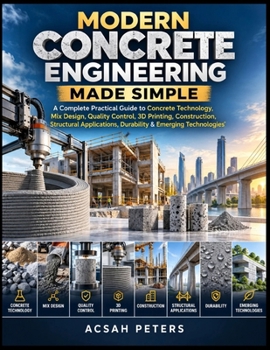
MODERN CONCRETE ENGINEERING MADE SIMPLE: A Complete Practical Guide to ConcreteTechnology,Mix Design,Quality Control,3D Printing,Construction,Structural Applications,Durability & Emerging Technologies

What should an engineer do when a concrete mix passes the laboratory test but performs differently on site?
The information engineers need is often scattered across materials science, structural design, construction, durability, and specialist technologies.
Laboratory results do not always explain what happens during transportation, placement, curing, and real site conditions.
Emerging technologies such as low-carbon binders, UHPC, sensors, AI, digital twins, and 3D concrete printing are changing the profession rapidly.
Modern Concrete Engineering Made Simple addresses these challenges through an integrated engineering workflow covering concrete materials, microstructure, hydration, mix design, fresh-concrete testing, quality control, construction execution, structural applications, durability, repair, sustainability, and advanced technologies. The outline emphasizes worked examples, troubleshooting, engineering interpretation, checklists, decision workflows, and practical field application rather than theory disconnected from practice.
Inside this Guide you will find:
Understand concrete microstructure and ITZ behavior.Evaluate cement, aggregates, admixtures, and SCMs.Control water-cementitious materials ratio.Develop practical concrete mix designs.Apply moisture corrections and trial-batch adjustments.Diagnose slump loss and segregation.Interpret strength-test results.Investigate failed concrete systematically.Improve placement and consolidation.Apply effective curing strategies.Understand foundations, slabs, beams, columns, and walls.Assess cracking, creep, shrinkage, and serviceability.Diagnose carbonation, chloride ingress, ASR, and sulfate attack.Evaluate low-carbon concrete, UHPC, SCC, geopolymers, and recycled aggregates.Understand smart concrete, sensing, digital twins, and 3D concrete printing.This is not positioned as a replacement for ACI, Eurocode, specialist standards, or established technical references. Instead, it serves as an accessible bridge between them-helping engineers connect principles with practical decisions. It is designed for civil and structural engineers, concrete technologists, construction professionals, QC specialists, consultants, and graduate students who need technical depth without unnecessary academic density.
If you want to stay current with sustainable and emerging concrete technologies, then use this handbook as your modern field reference.
Customer Reviews
ThriftBooks ® and the ThriftBooks ® logo are registered trademarks of Thrift Books Global, LLC
