


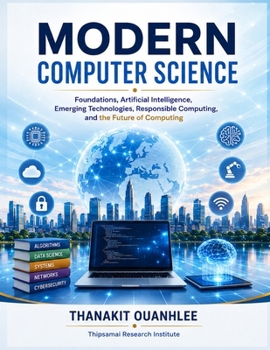
Modern Computer Science: Foundations, Artificial Intelligence, Emerging Technologies, Responsible Computing, and the Future of Computing
No Customer Reviews

Computer science is no longer defined by isolated advances in hardware, software, algorithms, or artificial intelligence. Modern computing emerges from the interaction of algorithms, data, computing infrastructure, networks, intelligent models, physical systems, human users, organisations, and governance.
Modern Computer Science: Foundations, Artificial Intelligence, Emerging Technologies, Responsible Computing, and the Future of Computing provides a comprehensive graduate-level examination of this changing discipline.
Organised into eight parts and twenty-seven chapters, the book begins with the intellectual and technical foundations of computer science before examining the technologies reshaping contemporary computing. Topics include the evolution of computing, data science, theory of computation and computational complexity, algorithms and data structures, programming languages and compilers, operating systems, databases, networks, machine learning and deep learning, foundation models and generative AI, AI agents, distributed computing, high-performance and quantum computing, big data, cybersecurity, blockchain, IoT and advanced connectivity.
The discussion then extends beyond technical capability to the wider challenges facing modern computing, including AI ethics and governance, sustainability, human-AI collaboration, robotics, embedded and high-integrity systems, human-computer interaction, generative AI in software engineering, open-source ecosystems, global technology competition, and the future of computer science.
Rather than treating emerging technologies as replacements for classical computer science, the book demonstrates how they extend, recombine, and expose the limits of established computing principles. Its systems-oriented perspective encourages readers to examine interactions among hardware, software, data, networks, AI, interfaces, organisations, and institutions.
The textbook also addresses a fundamental reality of contemporary computing: technical capability alone does not determine whether a system will succeed. Reliability, cybersecurity, privacy, governance, sustainability, human oversight, infrastructure, and institutional context increasingly influence what systems can be built and how they can responsibly be deployed.
Designed principally for postgraduate students, including MSc students in Data Science and Artificial Intelligence, the book is also suitable for computer science and AI students, computing professionals, researchers, educators, technology managers, and readers from adjacent disciplines seeking a rigorous understanding of the modern computing landscape.
Each chapter combines conceptual foundations with technical analysis, current evidence, international cases, critical evaluation, future directions, chapter summaries, key terms, discussion questions, and MSc-level exercises and research activities.
Modern Computer Science is not simply a catalogue of current technologies. Its purpose is to develop the analytical ability required to understand how computing systems work, how technologies converge, how trade-offs should be evaluated, and how computer science may evolve in an increasingly intelligent, connected, and computationally intensive world.
Modern Computer Science: Foundations, Artificial Intelligence, Emerging Technologies, Responsible Computing, and the Future of Computing provides a comprehensive graduate-level examination of this changing discipline.
Organised into eight parts and twenty-seven chapters, the book begins with the intellectual and technical foundations of computer science before examining the technologies reshaping contemporary computing. Topics include the evolution of computing, data science, theory of computation and computational complexity, algorithms and data structures, programming languages and compilers, operating systems, databases, networks, machine learning and deep learning, foundation models and generative AI, AI agents, distributed computing, high-performance and quantum computing, big data, cybersecurity, blockchain, IoT and advanced connectivity.
The discussion then extends beyond technical capability to the wider challenges facing modern computing, including AI ethics and governance, sustainability, human-AI collaboration, robotics, embedded and high-integrity systems, human-computer interaction, generative AI in software engineering, open-source ecosystems, global technology competition, and the future of computer science.
Rather than treating emerging technologies as replacements for classical computer science, the book demonstrates how they extend, recombine, and expose the limits of established computing principles. Its systems-oriented perspective encourages readers to examine interactions among hardware, software, data, networks, AI, interfaces, organisations, and institutions.
The textbook also addresses a fundamental reality of contemporary computing: technical capability alone does not determine whether a system will succeed. Reliability, cybersecurity, privacy, governance, sustainability, human oversight, infrastructure, and institutional context increasingly influence what systems can be built and how they can responsibly be deployed.
Designed principally for postgraduate students, including MSc students in Data Science and Artificial Intelligence, the book is also suitable for computer science and AI students, computing professionals, researchers, educators, technology managers, and readers from adjacent disciplines seeking a rigorous understanding of the modern computing landscape.
Each chapter combines conceptual foundations with technical analysis, current evidence, international cases, critical evaluation, future directions, chapter summaries, key terms, discussion questions, and MSc-level exercises and research activities.
Modern Computer Science is not simply a catalogue of current technologies. Its purpose is to develop the analytical ability required to understand how computing systems work, how technologies converge, how trade-offs should be evaluated, and how computer science may evolve in an increasingly intelligent, connected, and computationally intensive world.
Format:Paperback
Language:English
ISBN:B0HFMQCXGH
ISBN13:9798193413806
Release Date:August 2026
Publisher:Independently Published
Length:556 Pages
Weight:2.80 lbs.
Dimensions:1.1" x 8.5" x 11.0"
Customer Reviews
0 rating
Copyright © 2026 Thriftbooks.com
Terms of Use | Privacy Policy | Do Not Sell/Share My Personal Information | Cookie Notice | Cookie Preferences | Accessibility Statement
ThriftBooks ® and the ThriftBooks ® logo are registered trademarks of Thrift Books Global, LLC
ThriftBooks ® and the ThriftBooks ® logo are registered trademarks of Thrift Books Global, LLC
