


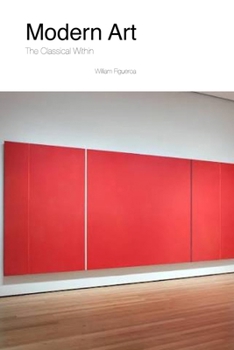
Modern Art The Classical Within

Select Format
Select Condition 
Book Overview
Modern art is often understood as a break with the past - a rejection of clas-
sical form, proportion, and tradition. Yet when the history of art is viewed
across its full span, a different pattern begins to appear. From the earli-
est monumental structures to the luminous spaces of Gothic cathedrals,
from the geometry of Greek sculpture to the discoveries of Renaissance
perspective, artists and architects repeatedly reveal a common structural
condition: the intelligible order underlying form. Proportion, geometry,
rhythm, and light emerge again and again as the grammar through which
form becomes coherent. Modern abstraction does not abandon this tradi-
tion. It brings it into full view.
Beginning with C zanne's structural reorganization of nature and continu-
ing through Cubism, geometric abstraction, and the color-field paintings
of the twentieth century, representation gradually recedes. What remains
is the relational structure that has always governed form. Through a sweep-
ing historical investigation that moves from ancient architecture to modern
painting, Modern Art: The Classical Within traces the progressive recog-
nition of this intelligible order across civilizations and centuries. Seen in
this light, modern abstraction is not a rupture with the classical condition
but its most explicit disclosure. The intelligible never vanishes. It simply
waits to be consciously acknowledged.
Customer Reviews
ThriftBooks ® and the ThriftBooks ® logo are registered trademarks of Thrift Books Global, LLC
