


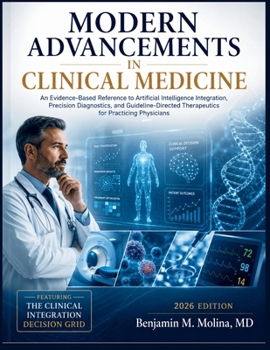
Modern Advancements in Clinical Medicine: An Evidence-Based Reference to Artificial Intelligence Integration, Precision Diagnostics, and Guideline-Dir

Modern clinical medicine now depends on more than diagnosis and treatment alone. This reference connects artificial intelligence, computational imaging, precision diagnostics, predictive analytics, guideline-directed therapeutics, robotics, wearable monitoring, and digital health systems to the decisions practicing physicians make at the bedside, in clinic, and across longitudinal care. Built around The Clinical Integration Decision Grid, it shows how technology-generated signals become safe clinical action only when evidence, context, patient goals, and safety boundaries are verified.
What This Book Puts in Your Hands
- Interpret AI and predictive models - distinguish detection, classification, risk prediction, calibration, bias, and drift before acting on algorithmic output.
- Use computational imaging and diagnostic confidence tools - connect segmentation, radiomics, heatmaps, super-resolution, and human-in-the-loop review to defensible diagnostic decisions.
- Translate biomarkers into treatment selection - apply molecular diagnostics, companion testing, and precision oncology without overreading uncertain or incidental findings.
- Apply guideline-directed therapy in real patients - account for contraindications, polypharmacy, renal adjustment, monitoring, shared decision-making, and treatment burden.
- Manage technology-augmented perioperative care - map risk assessment, hemodynamic monitoring, sedation strategy, regional anesthesia, and pain recovery to safety checkpoints.
- Integrate specialty applications - use modern pathways for femur fracture rehabilitation, ENT evaluation, Alzheimer's disease, CKD progression, and oncologic detection.
- Govern digital health, wearables, robotics, and AI - evaluate validation, regulation, equity, alert fatigue, post-deployment monitoring, and deimplementation.
Choose this reference to bring innovation into clinical practice with the discipline, skepticism, and accountability patients require.
Customer Reviews
ThriftBooks ® and the ThriftBooks ® logo are registered trademarks of Thrift Books Global, LLC
