


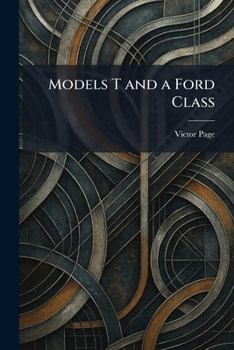
Models T and a Ford Class

"Models T and a Ford Class" is an authoritative technical guide and historical examination of the two vehicles that defined early American motoring. Written by the esteemed automotive engineer Victor Pag , this work provides a comprehensive look at the mechanical design, operation, and maintenance of the Ford Model T and the Model A during a pivotal era of transportation.
The book delves into the specific engineering features of each model, offering detailed explanations of the engines, ignition systems, carburetors, and transmission mechanisms. Pag presents the material with a focus on practical utility, making it an indispensable resource for mechanics and car owners of the late 1920s who sought to understand the inner workings of their vehicles. By comparing the revolutionary but simple Model T with its more sophisticated successor, the Model A, the text illustrates the significant technological leaps made in automotive manufacturing and design.
As both a practical manual and a piece of industrial history, "Models T and a Ford Class" captures the foundational principles of the Ford Motor Company's success. It serves as a vital reference for vintage automobile enthusiasts, restorers, and historians interested in the evolution of the modern car and the mechanical innovations that put the world on wheels.
This work has been selected by scholars as being culturally important, and is part of the knowledge base of civilization as we know it. This work was reproduced from the original artifact, and remains as true to the original work as possible. Therefore, you may see the original copyright references, library stamps (as most of these works have been housed in our most important libraries around the world), and other notations in the work.
This work is in the public domain in the United States of America, and possibly other nations. Within the United States, you may freely copy and distribute this work, as no entity (individual or corporate) has a copyright on the body of the work.
As a reproduction of a historical artifact, this work may contain missing or blurred pages, poor pictures, errant marks, etc. Scholars believe, and we concur, that this work is important enough to be preserved, reproduced, and made generally available to the public. We appreciate your support of the preservation process, and thank you for being an important part of keeping this knowledge alive and relevant.
Customer Reviews
ThriftBooks ® and the ThriftBooks ® logo are registered trademarks of Thrift Books Global, LLC
