


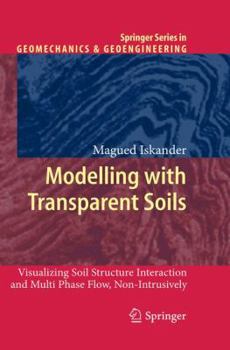
Modelling with Transparent Soils: Visualizing Soil Structure Interaction and Multi Phase Flow, Non-Intrusively
No Customer Reviews

Select Format
Select Condition 
Book Overview
up with automated systems for assessment of road condition. For example, Haas et al (1997) developed an automated algorithm for detecting cracks and joints con- tion. Smith and Lin (1997) developed a fuzzy logic classification scheme for pavement distress condition. Oh et al (1997) developed iterative algorithm for overcoming noisy images of roads due to shadows and low light conditions. Koustsopoulos and Mishalani (1997) presented a model for distress assessment in a local (microscopic) and global (macroscopic) level using captured images of pavement. Lee (1993) presented a comparison between 15 different imaging al- rithms used in crack detection. Ground Penetration Radar (GPR) has also been used for pavement assessment. Special computer algorithms were developed for quick analysis of GPR data (Adeli & Hung 1993 and Maser 1996). Heiler and McNeil (1997) proposed a modified system for analyzing the GPR data using an artificial neural network (ANN). 2.3.2 Traffic Analysis and Control Currently imaging systems provide essential data for transportation and traffic engineering planning (Anon 1999). Machine vision techniques were introduced to intersection traffic signal control in the late 1970's (Chou and Sethi 1993). No- days, many systems have been developed all over the world for traffic analysis and control applications, in addition to image based systems for traffic violations. Nallamathu and Wang (1997) developed one of the first automated systems for license plate recognition using character recognition algorithm for the use in monitoring violators at toll stations and many other traffic applications.
Format:Hardcover
Language:English
ISBN:3642025005
ISBN13:9783642025006
Release Date:June 2010
Publisher:Springer
Length:335 Pages
Weight:1.35 lbs.
Dimensions:1.0" x 6.1" x 9.2"
Related Subjects
Engineering Science Science & Math Science & Scientists Science & Technology TechnologyCustomer Reviews
0 rating
Copyright © 2026 Thriftbooks.com Terms of Use
| Privacy Policy | Do Not
Sell/Share My Personal Information | Cookie Policy | Cookie Preferences | Accessibility Statement
ThriftBooks® and the ThriftBooks® logo are registered trademarks of Thrift Books Global, LLC
ThriftBooks® and the ThriftBooks® logo are registered trademarks of Thrift Books Global, LLC
