


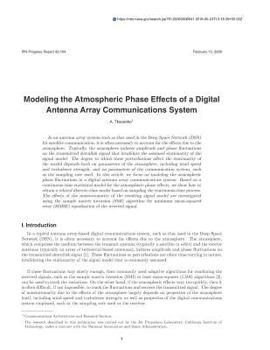
Modeling the Atmospheric Phase Effects of a Digital Antenna Array Communications System
No Customer Reviews

In an antenna array system such as that used in the Deep Space Network (DSN) for satellite communication, it is often necessary to account for the effects due to the atmosphere. Typically, the atmosphere induces amplitude and phase fluctuations on the transmitted downlink signal that invalidate the assumed stationarity of the signal model. The degree to which these perturbations affect the stationarity of the model depends both on parameters of the atmosphere, including wind speed and turbulence strength, and on parameters of the communication system, such as the sampling rate used. In this article, we focus on modeling the atmospheric phase fluctuations in a digital antenna array communications system. Based on a continuous-time statistical model for the atmospheric phase effects, we show how to obtain a related discrete-time model based on sampling the continuous-time process. The effects of the nonstationarity of the resulting signal model are investigated using the sample matrix inversion (SMI) algorithm for minimum mean-squared error (MMSE) equalization of the received signalTkacenko, A.Jet Propulsion LaboratoryANTENNA ARRAYS; SATELLITE COMMUNICATION; MATHEMATICAL MODELS; ATMOSPHERIC MODELS; ATMOSPHERIC EFFECTS; DEEP SPACE NETWORK; PERTURBATION; TURBULENCE; WIND VELOCITY
Format:Paperback
Language:English
ISBN:1723743526
ISBN13:9781723743528
Release Date:January 1
Publisher:Independently Published
Length:30 Pages
Weight:0.21 lbs.
Dimensions:0.1" x 8.5" x 11.0"
Customer Reviews
0 rating
Copyright © 2025 Thriftbooks.com
Terms of Use | Privacy Policy | Do Not Sell/Share My Personal Information | Cookie Policy | Cookie Preferences | Accessibility Statement
ThriftBooks ® and the ThriftBooks ® logo are registered trademarks of Thrift Books Global, LLC
ThriftBooks ® and the ThriftBooks ® logo are registered trademarks of Thrift Books Global, LLC
