


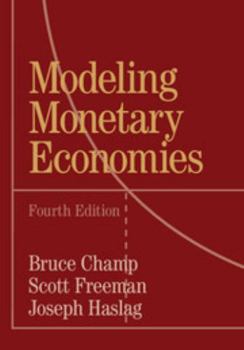
Modeling Monetary Economies

Select Format
Select Condition 
Book Overview
Thoroughly updated and expanded with a new chapter on blockchain and increased coverage of cryptocurrency, as well as new data, this established advanced undergraduate textbook approaches the subject... This description may be from another edition of this product.
Format:Paperback
Language:English
ISBN:1316508676
ISBN13:9781316508671
Release Date:May 2016
Publisher:Cambridge University Press
Length:400 Pages
Weight:1.65 lbs.
Dimensions:0.9" x 7.0" x 9.9"
Customer Reviews
4 ratings
Review of the book I just bought
Published by Thriftbooks.com User , 16 years ago
This book is just what I need and want! Good book for economis and business learners.
Beautiful; economics as it should be written
Published by Thriftbooks.com User , 22 years ago
Economists have a responsiblity to communicate as simply as possible. Too often complex mathematics are an egotistic tool of the economist that merely frustrates the reader. Champ and Freeman's Modeling Monetary Economies is a wonderful volume that explains tough issues in monetary economics by building upon Wallace and Bryant's overlapping generations (OLG) model.The OLG framework is a very simple framework that has its limitations, yet it is a powerful explanatory device. Champ and Freeman apply it to the following exercises:* Introduce money into an economy--any grad student of economics (as I once was) will tell you this is no simple task! We take money for granted, of course, but mathematical models tend to imply that money is unnecessary! Just getting money into an economic model without unreasonable assumptions is itself an accomplishment.* Inflation--again, not easy to do in other mathematical models of money--and anticipated inflation* International currency exchange and the indeterminancy of the exchange rate* Central banking and changes to the money supply* Banks and lending* Deficits and the national debt* The interaction of all of the aboveThe book also has exercises in it that apply and extend the models introduced in each chapter.RECOMMENDATIONI recommend this book for advanced year undergrads (in mathematical econ programs) and graduate students. It really is a great book that builds a conceptual knowledge of the interaction of the various components of monetary economics. This is useful for understanding more complicated dynamic optimization models. And it provides models that are useful in their own right and relevant as the basis for further (ie., dissertation) research.
A thoughtful introduction to mathematical economics
Published by Thriftbooks.com User , 24 years ago
This book is an example of how mathematics is intelligently used in economics, and the understanding of the latter is thereby enhanced. Only basic algebra is used, yet the authors are able to make non-trivial explanation about economic phenomena, from why money must exist to inflation to payment system. The text is mathematical and abstract, but as I read it, my frame of mind remains firmly that of an economist, and not of a mathematician (which is as it should be). The text is carefully written, flowing and anticipative of difficulties that a reader may have.This is not an introductory text to economics, and I reject the idea that those with strong mathematical background should be introduced to economics in a different way from others. Any beginner, mathematical or not, should read Samuelson and the like first.
Academic, organized, and extremely concise
Published by Thriftbooks.com User , 26 years ago
This book is a very good introduction to quantative monetary theories. Readers with science or engineering background can especially benefit from authors' concise mathematical expressions. It gives a clear and academic view about fundamental theories, so don't expect to see a lot of economical data or "stories".
Copyright © 2026 Thriftbooks.com
Terms of Use | Privacy Policy | Do Not Sell/Share My Personal Information | Cookie Policy | Cookie Preferences | Accessibility Statement
ThriftBooks ® and the ThriftBooks ® logo are registered trademarks of Thrift Books Global, LLC
ThriftBooks ® and the ThriftBooks ® logo are registered trademarks of Thrift Books Global, LLC
