


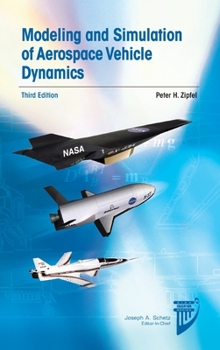
Modeling and Simulation of Aerospace Vehicle Dynamics

Provides the reader with a complete set of tools to build, program, and execute simulations. This title uses tensors for modeling flight dynamics in a form invariant under coordinate transformations.... This description may be from another edition of this product.
Format:Hardcover
Language:English
ISBN:1624102506
ISBN13:9781624102509
Release Date:July 2014
Publisher:AIAA (American Institute of Aeronautics & Ast
Length:661 Pages
Weight:2.86 lbs.
Dimensions:1.5" x 6.4" x 9.2"
Customer Reviews
1 rating
Here we have a modern Flight Dynamics treatise!
Published by Thriftbooks.com User , 23 years ago
Comments on "Modeling and Simulation of Aerospace Vehicle Dynamics"Here we have a modern Flight Dynamics treatise!Dr. Zipfel presents his book as an account of Modeling and Simulation techniques; in fact, it is much more: it is, as we just said, a modern, exhaustive and deep Flight Dynamics treatise. In the first six chapters, where Dr. Zipfel presents the theoretical foundations of Flight Dynamics, he introduces the reader to the very powerful, elegant and concise Tensorial formulation (which is uncommon except in very few, specialized reports), which is elevated to an axiomatic level ("from tensor modeling to matrix coding", in his words). This formulation, when applied to the Rational Mechanics and Modeling chapters(2 to 6), should allow the undergraduate (or recently graduated) student to see and enjoy the power and beauty underlying in these old physics branch. These chapters could configure an excellent text as part of a Mechanical or Aeronautical Engineering graduated level Rational Mechanics course (which we will intend to verify in the following course at National University of Córdoba, Argentina).The second part of the book (which we should define as the "Aerospace" part), is devoted to Aerospace System simulation itself: beginning (in Chapter 7) with a blow of fresh air on our old, loved Perturbation Equations introducing the reader in the specificities of the Flight Dynamics (i.e. Aerodynamic forces and moments modeling), Dr. Zipfel leads with the most awkward part of Dynamics Analysis: The modeling of complete vehicles (regardless they are planes, missiles, launch vehicles or spacecrafts), in which the range of subsystems, and links between them, involved may feel sick to the beginner (and, sometimes, to experienced engineers). Again, beginning with basics (3-D.O.F. modeling), the reader is conveyed in a simultaneously strict an pleasant way to the deeps of full 6-D.O.F. simulations, including items such as Control, Guidance and Navigation Systems, Seekers, full non-linear aerodynamics and stochastic effects. The specialized engineer will find these Chapters as primary reference for any concrete modeling task.The primary tool used by Dr. Zipfel in his task is CADAC software (Computer Aided Design of Aerospace Concepts), which we see as one of the bests Aerospace Simulation open codes available worldwide. Its modularity, documentation and completeness allow the reader to quickly understanding, as well as to perform modifications to suit it to specific needs. This software is highly valuable both for students and specialized engineers needed to develop simulation tools.In brief, we found Modeling and Simulation of Aerospace Vehicle Dynamics a great book for both engineering students and specialized engineers; everybody will enjoy reading it, because its elegant and concise notation and its deep and rigorous mathematical treatment, as well as the powerful tools that Dr. Zipfel puts in the engineers' hands. This book should be on the des
Copyright © 2026 Thriftbooks.com Terms of Use
| Privacy Policy | Do Not
Sell/Share My Personal Information | Cookie Policy | Cookie Preferences | Accessibility Statement
ThriftBooks® and the ThriftBooks® logo are registered trademarks of Thrift Books Global, LLC
ThriftBooks® and the ThriftBooks® logo are registered trademarks of Thrift Books Global, LLC
