


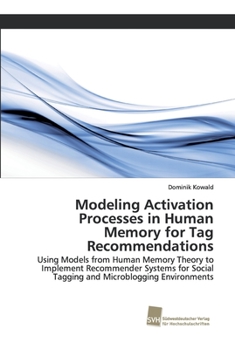
Modeling Activation Processes in Human Memory for Tag Recommendations
No Customer Reviews

Social tagging systems enable users to collaboratively assign freely chosen keywords (i.e., tags) to resources (e.g., Web links). In order to support users in finding descriptive tags, tag recommendation algorithms have been proposed. One issue of current state-of-the-art tag recommendation algorithms is that they are often designed in a purely data-driven way and thus, lack a thorough understanding of the cognitive processes that play a role when people assign tags to resources. A prominent example is the activation equation of the cognitive architecture ACT-R, which formalizes activation processes in human memory to determine if a specific memory unit (e.g., a word or tag) will be needed in a specific context. It is the aim of this thesis to investigate if a cognitive-inspired approach, which models activation processes in human memory, can improve tag recommendations. The findings of this thesis demonstrate that activation processes in human memory can be utilized to improve not only social tag recommendations but also hashtag recommendations. This opens up a number of possible research strands for future work, such as the design of cognitive-inspired recommender systems.
Format:Paperback
Language:English
ISBN:6202320729
ISBN13:9786202320726
Release Date:November 2017
Publisher:Sudwestdeutscher Verlag Fur Hochschulschrifte
Length:168 Pages
Weight:0.56 lbs.
Dimensions:0.4" x 6.0" x 9.0"
Customer Reviews
0 rating
Copyright © 2026 Thriftbooks.com Terms of Use
| Privacy Policy | Do Not
Sell/Share My Personal Information | Cookie Policy | Cookie Preferences | Accessibility Statement
ThriftBooks® and the ThriftBooks® logo are registered trademarks of Thrift Books Global, LLC
ThriftBooks® and the ThriftBooks® logo are registered trademarks of Thrift Books Global, LLC
