


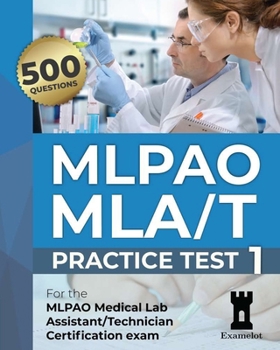
MLPAO MLA/T Certification Exam: Practice Test 1
No Customer Reviews

MLPAO Exam Practice Questions: Prepare for Success This is the first book in the series. See the complete series at amazon.ca/dp/B08Z459HTG. Looking for an effective way to prepare for the Medical Laboratory Professionals' Association of Ontario (MLPAO) exam? This book of practice questions is for you With 500 multiple-choice questions, this book covers all of the major topics on the MLPAO exam, including medical terminology, clinical hematology, clinical chemistry, transfusion medicine, clinical microbiology, and more. Each question is designed to closely resemble the types of questions you'll encounter on the actual exam, so you can practice with confidence and get a feel for the exam format. Included in this book: 500 multiple-choice questions divided into the 13 competencies of the examExplanations for the answers to every question, helping you to better understand the answersValuable information about the MLPAO exam to help you approach test day with confidence
---SAMPLE QUESTIONS--- Here are four sample questions from the book: 1) STANDARDS OF PRACTICE
Which of these laws primarily concerns data privacy?
a. Canada Health Act
b. HCCA
c. Ontario Regulation 107/96 Controlled Act
d. PIPEDA
e. RHPA Answer: d. PIPEDA
Explanation: PIPEDA (the Personal Information Protection and Electronic Documents Act) is a Canadian federal law for data privacy. It governs how private sector organizations collect, use, and disclose personal information in the course of business. 2) MEDICAL TERMINOLOGY
What does the term "comorbidity" mean?
a. A clinically insignificant condition
b. A disease passed onto someone else
c. A disease present in two or more patients
d. The death of two patients at the same time
e. Two or more health conditions in the same patient Answer: e. Two or more health conditions in the same patient
Explanation: Comorbidity refers to two or more medical conditions in a single patient. These conditions can interact with each other in complex ways. 3) BASIC BIOLOGY, ANATOMY AND PHYSIOLOGY
Occipital, sphenoid, frontal, temporal, and ethmoid are bones of which part of the body?
a. Cranium
b. Face
c. Pelvis
d. Spine
e. Thorax Answer: a. Cranium
Explanation: These bones form the cranium (skull), which encloses and protects the brain. 4) LABORATORY MATHEMATICS AND QUALITY MANAGEMENT
How would you prepare a 50 mL 1/10 dilution of bleach?
a. 3 mL of bleach to 47 mL of water
b. 4 mL of bleach to 46 mL of water
c. 5 mL of bleach to 45 mL of water
d. 6 mL of bleach to 44 mL of water
e. 7 mL of bleach to 43 mL of water Answer: c. 5 mL of bleach to 45 mL of water
Explanation: 1/10 is a dilution factor of 10. It means the volume of the solution is 10 times higher than the volume of the solute. The formula for the dilution factor is:
dilution factor = final volume/solute volume This formula can be rearranged as:
solute volume = final volume/dilution factor Inserting the values from the question into the formula:
solute volume = 50 mL/10 = 5 mL We calculate the amount of water needed by subtracting the amount of bleach from the total volume:
50 mL - 5 mL = 45 mL
---SAMPLE QUESTIONS--- Here are four sample questions from the book: 1) STANDARDS OF PRACTICE
Which of these laws primarily concerns data privacy?
a. Canada Health Act
b. HCCA
c. Ontario Regulation 107/96 Controlled Act
d. PIPEDA
e. RHPA Answer: d. PIPEDA
Explanation: PIPEDA (the Personal Information Protection and Electronic Documents Act) is a Canadian federal law for data privacy. It governs how private sector organizations collect, use, and disclose personal information in the course of business. 2) MEDICAL TERMINOLOGY
What does the term "comorbidity" mean?
a. A clinically insignificant condition
b. A disease passed onto someone else
c. A disease present in two or more patients
d. The death of two patients at the same time
e. Two or more health conditions in the same patient Answer: e. Two or more health conditions in the same patient
Explanation: Comorbidity refers to two or more medical conditions in a single patient. These conditions can interact with each other in complex ways. 3) BASIC BIOLOGY, ANATOMY AND PHYSIOLOGY
Occipital, sphenoid, frontal, temporal, and ethmoid are bones of which part of the body?
a. Cranium
b. Face
c. Pelvis
d. Spine
e. Thorax Answer: a. Cranium
Explanation: These bones form the cranium (skull), which encloses and protects the brain. 4) LABORATORY MATHEMATICS AND QUALITY MANAGEMENT
How would you prepare a 50 mL 1/10 dilution of bleach?
a. 3 mL of bleach to 47 mL of water
b. 4 mL of bleach to 46 mL of water
c. 5 mL of bleach to 45 mL of water
d. 6 mL of bleach to 44 mL of water
e. 7 mL of bleach to 43 mL of water Answer: c. 5 mL of bleach to 45 mL of water
Explanation: 1/10 is a dilution factor of 10. It means the volume of the solution is 10 times higher than the volume of the solute. The formula for the dilution factor is:
dilution factor = final volume/solute volume This formula can be rearranged as:
solute volume = final volume/dilution factor Inserting the values from the question into the formula:
solute volume = 50 mL/10 = 5 mL We calculate the amount of water needed by subtracting the amount of bleach from the total volume:
50 mL - 5 mL = 45 mL
Format:Paperback
Language:English
ISBN:B08KV3RLGC
ISBN13:9798692182098
Release Date:October 2020
Publisher:Independently Published
Length:236 Pages
Weight:1.05 lbs.
Dimensions:0.5" x 8.0" x 10.0"
Customer Reviews
0 rating
Copyright © 2026 Thriftbooks.com Terms of Use
| Privacy Policy | Do Not
Sell/Share My Personal Information | Cookie Policy | Cookie Preferences | Accessibility Statement
ThriftBooks® and the ThriftBooks® logo are registered trademarks of Thrift Books Global, LLC
ThriftBooks® and the ThriftBooks® logo are registered trademarks of Thrift Books Global, LLC
