


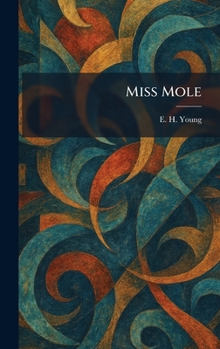
Miss Mole


Select Format
Select Condition 
Book Overview
"Miss Mole" is a sharp-witted and celebrated work of English domestic fiction that masterfully blends social satire with deep psychological insight. The novel centers on Hannah Mole, a middle-aged, penniless, but fiercely independent woman who navigates the rigid social structures of early 20th-century provincial England with irony and resilience. Working as a companion and later as a housekeeper for the pompous Reverend Robert Corder and his family in the city of Radstowe, Hannah must balance her vibrant inner life and hidden past with the outward expectations of her status.
E. H. Young crafts a nuanced character study of an "unremarkable" woman whose intelligence and biting humor allow her to see through the hypocrisy of those around her. As Hannah becomes an indispensable part of the Corder household, her influence begins to shift the family dynamics, leading to moments of both quiet tension and unexpected revelation. A winner of the James Tait Black Memorial Prize, "Miss Mole" is a sophisticated exploration of class, the constraints placed upon women, and the quiet triumphs of the human spirit. This literary gem remains a testament to Young's ability to find extraordinary depth in the complexities of everyday domestic life.
This work has been selected by scholars as being culturally important, and is part of the knowledge base of civilization as we know it. This work was reproduced from the original artifact, and remains as true to the original work as possible. Therefore, you may see the original copyright references, library stamps (as most of these works have been housed in our most important libraries around the world), and other notations in the work.
This work is in the public domain in the United States of America, and possibly other nations. Within the United States, you may freely copy and distribute this work, as no entity (individual or corporate) has a copyright on the body of the work.
As a reproduction of a historical artifact, this work may contain missing or blurred pages, poor pictures, errant marks, etc. Scholars believe, and we concur, that this work is important enough to be preserved, reproduced, and made generally available to the public. We appreciate your support of the preservation process, and thank you for being an important part of keeping this knowledge alive and relevant.
Customer Reviews
A stunningly good novel
The world aslant
ThriftBooks ® and the ThriftBooks ® logo are registered trademarks of Thrift Books Global, LLC
