


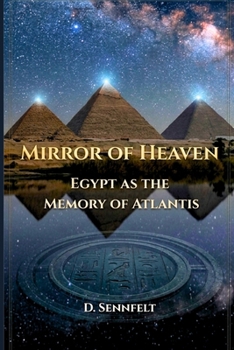
Mirror of Heaven: Egypt as the Memory of Atlantis

What were the pyramids actually built for?
Two centuries of Egyptology have decoded the hieroglyphs, surveyed the monuments to the millimetre, and catalogued every god in the Egyptian pantheon. The archaeologists have answered the question with power. The astronomers have answered with stellar alignments. The mythologists have answered with symbol systems whose origins they have never been able to locate. None of them has answered with the geography.
This book argues that Egypt was built as the deliberate full-scale memorial of a lost civilisation - that the Nile valley mirrors the Awash valley of East Africa, that Thebes mirrors the Ethiopian highlands, that the Giza plateau mirrors the volcanic plateau of Dama Ali in the Afar Depression where the original kingdom stood, and that every temple, every pyramid, every god in the Egyptian pantheon was placed where it was placed, and named what it was named, to preserve the memory of the drowned paradise the Afar lake region once held. Egypt is not the source of its own theology. Egypt is the memorial of someone else's.
Drawing on the prehistoric lake sediment cores of the Afar Depression, the stellar targets encoded in the Great Pyramid's shafts, the Nile valley's zodiacal geography, and a temple-by-temple examination of the Egyptian pantheon's African origins, Mirror of Heaven traces the complete knowledge system of the drowned Afar civilisation from its prehistoric origin above a paleolake to its deliberate reconstruction in the monuments of the Nile.
This is a voyage through the old Kingdom of the Gods, the Kingdom of Heaven that Egypt was built to remember. Temple by temple, god by god, the book recovers what Egypt was, why it was built, and what it has been quietly saying for five thousand years.
A meditation on memory, geography, and the African origins of the world's longest-living civilisation.
Customer Reviews
ThriftBooks ® and the ThriftBooks ® logo are registered trademarks of Thrift Books Global, LLC
