


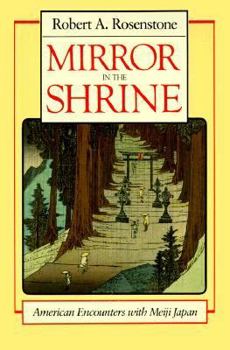
Mirror in the Shrine: American Encounters with Meiji Japan


Select Format
Select Condition 
Book Overview
Cross-cultural contacts between America and Japan in the nineteenth-century are typified in the stories of three visitors--missionary William Elliot Griffis, scientist Edward S. Morse, and writer Lafeadio Hern.
Format:Hardcover
Language:English
ISBN:0674576411
ISBN13:9780674576414
Release Date:September 1988
Publisher:Harvard University Press
Length:336 Pages
Weight:1.55 lbs.
Dimensions:9.8" x 1.0" x 6.5"
Customer Reviews
3 ratings
A New Way of Telling the Past
Published by Thriftbooks.com User , 21 years ago
This story is about three Americans (Willie Griffis, Edward Morse, and Lafcadio Hearn) who visited Japan in the 1800s and had their lives "altered greatly" by the experience. Unconventional in both style and form, and explicitly subjective - even self relexive - the book is nevertheless interesting, informing, and challenging. Moreover, it is exactly what Rosenstone purports it to be -- a new way of telling the past. His aim is to "break with some of the conventions of narrative history, and to move beyond the 'realistic' nineteenth-century novel as a paradigm for the historian's 'art'." Yet despite this new approach, the author keeps 'reality' in check by combining stylistic innovation with sound research.Rosenstone writes in the present tense - both in the first and second person - and as the 'Biographer', whose comments appear much like side takes in television documentaries. A & E anyone? In any case, the technique, scorned by most conventional historians, is quite successful. Instead of reinforcing the dichotomy between 'true' history and film, Rosenstone establishes a truce between them - one might even say a 'relationship'. In short, 'Mirror in the Shrine' is thoughtful, entertaining, and highly recommended -- and certainly not dry.
Very interesting, but also very dry...
Published by Thriftbooks.com User , 24 years ago
A book about how Japan was changing Americans NOT just on how America (and the West) was changing the Japanese. It focuses on William E. Griffis, Edward S. Morse, and Lafcadio Hearn (whose names you will find many times within history books about Japan). Their different writings (with their different ideas, backgrounds and view points) allow us to see how Americans responded to visiting and living within Japan.I have to warn you, the book is somewhat dry(the other review compared it to A & E) but worth reading for those of us who love Japanese history.
A New Way of Telling the Past
Published by Thriftbooks.com User , 26 years ago
Essentially, the 'story' was about three Americans (Willie Griffis, Edward Morse, and Lafcadio Hearn) visiting Japan in the 1800s who had their lives permanently changed by the experience. Unconventional in both style and form, and explicitly subjective - even self-reflexive - the book was nonetheless interesting, informing, and challenging. Moreover, it was exactly what Robert Rosenstone purported it to be: a new way of telling the past. His aim was to "break with some of the conventions of narrative history, and to move beyond the 'realistic' nineteenth-century novel as a paradigm for the historian's 'art'." While the technique itself was effective, the author kept 'reality' in check by combining this unorthodox approach with sound research.The author's interest in historical fims was evident from the outset. Clearly, his "notion of writing as a motion picture camera" was carried through to the fullest extent. Rosenstone wrote in the present tense, both in the second person (addressing the reader and, less frequently, the characters) and in the first person (of the characters). No use of 'proper' quotations was made, and the characters' comments were injected - yes, from documentation, not guesswork - into italicised words, sentences, and even entire paragraphs. In addition, a person called "The Biographer' crept in once in a while to explain methodological and historical problems. Such comments appeared much like side takes in television documentaries. A & E anyone? In any case, the method, scorned by most conventional historians, was quite successful. Instead of reinforcing the dichotomy between 'true' history and film, Rosenstone established a truce between them - one might even say a 'relationship'. That traditionalists are likely to question the author's technique is undeniable, but they have no grounds for criticising his honesty. By that is simply meant that he had a straightforward thesis. He looked not at how his three American subjects changed Japan, but at how Japan changed them, about their lives having been "altered greatly...in ways they did not fully understand." Having lived in Japan himself, albeit almost a century later, Rosenstone undoubtedly experienced some of the same 'feelings' and 'alterations' as Griffis, Morse, and Hearn. Sound relativistic? That choice was entirely deliberate. Probably, the author's stay in Japan resulted in a new attitude about historical studies. Maybe, it was the result of seeing things differently, 'unconventionally'. Regardless, he is very aware of the change, and it was reflected in his historical writing, which showed that the use of new techniques AND traditional modes of research can indeed result in new ways of telling the past. For that reason alone, 'Mirror in the Shrine' was enjoyable and provocative, and is certainly highly recommended.
Copyright © 2026 Thriftbooks.com
Terms of Use | Privacy Policy | Do Not Sell/Share My Personal Information | Cookie Policy | Cookie Preferences | Accessibility Statement
ThriftBooks ® and the ThriftBooks ® logo are registered trademarks of Thrift Books Global, LLC
ThriftBooks ® and the ThriftBooks ® logo are registered trademarks of Thrift Books Global, LLC
