


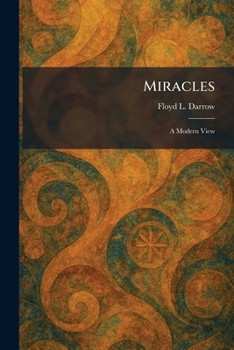
Miracles: A Modern View

Select Format
Select Condition 
Book Overview
"Miracles a Modern View" explores the complex intersection of religious faith and the evolving scientific landscape of the early 20th century. Written during a pivotal era of intellectual transition, this work addresses one of the most enduring debates in theology: the reconciliation of biblical miracles with the rigid laws of nature as defined by modern science. Author Floyd L. Darrow examines whether supernatural events can maintain their significance in an age increasingly dominated by rationalism and empirical discovery.
The text provides a rigorous analysis of traditional religious narratives, attempting to bridge the gap between ancient scripture and the intellectual requirements of the modern mind. It reflects the broader movement of Religious Modernism, which sought to adapt spiritual truths to harmonize with contemporary advancements in physics, biology, and historical criticism.
This work is a vital resource for those interested in the history of ideas, the philosophy of religion, and the long-standing dialogue between science and spirituality. "Miracles a Modern View" stands as a thoughtful investigation into the possibility of a faith that survives and thrives alongside scientific progress.
This work has been selected by scholars as being culturally important, and is part of the knowledge base of civilization as we know it. This work was reproduced from the original artifact, and remains as true to the original work as possible. Therefore, you may see the original copyright references, library stamps (as most of these works have been housed in our most important libraries around the world), and other notations in the work.
This work is in the public domain in the United States of America, and possibly other nations. Within the United States, you may freely copy and distribute this work, as no entity (individual or corporate) has a copyright on the body of the work.
As a reproduction of a historical artifact, this work may contain missing or blurred pages, poor pictures, errant marks, etc. Scholars believe, and we concur, that this work is important enough to be preserved, reproduced, and made generally available to the public. We appreciate your support of the preservation process, and thank you for being an important part of keeping this knowledge alive and relevant.
Customer Reviews
ThriftBooks ® and the ThriftBooks ® logo are registered trademarks of Thrift Books Global, LLC
