


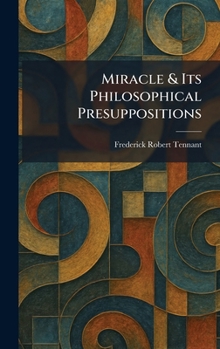
Miracle & Its Philosophical Presuppositions

"Miracle & Its Philosophical Presuppositions" provides a profound examination of the intellectual and metaphysical foundations required to understand the concept of a miracle. Written by Frederick Robert Tennant, this work navigates the complex intersection of science, philosophy, and theology to explore how the supernatural is conceptualized within a world governed by natural law. The text investigates the specific logical presuppositions that allow for the possibility of miraculous occurrences, challenging the reader to consider the epistemological requirements of faith.
Throughout the volume, Tennant addresses the tensions between rational inquiry and religious belief, offering a rigorous analysis of how miracles are defined and defended. By examining various philosophical systems, the work sheds light on the internal consistency of religious worldviews and their relationship to empirical reality. "Miracle & Its Philosophical Presuppositions" stands as a significant contribution to the philosophy of religion, providing a scholarly and timeless exploration of one of theology's most enduring questions. This work is an invaluable resource for students of religious thought, historical theology, and the history of ideas.
This work has been selected by scholars as being culturally important, and is part of the knowledge base of civilization as we know it. This work was reproduced from the original artifact, and remains as true to the original work as possible. Therefore, you may see the original copyright references, library stamps (as most of these works have been housed in our most important libraries around the world), and other notations in the work.
This work is in the public domain in the United States of America, and possibly other nations. Within the United States, you may freely copy and distribute this work, as no entity (individual or corporate) has a copyright on the body of the work.
As a reproduction of a historical artifact, this work may contain missing or blurred pages, poor pictures, errant marks, etc. Scholars believe, and we concur, that this work is important enough to be preserved, reproduced, and made generally available to the public. We appreciate your support of the preservation process, and thank you for being an important part of keeping this knowledge alive and relevant.
Customer Reviews
ThriftBooks ® and the ThriftBooks ® logo are registered trademarks of Thrift Books Global, LLC
