


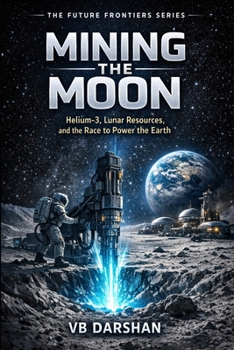
Mining the Moon: Helium-3, Lunar Resources, and the Race to Power the Earth

The Moon is not barren. It is a warehouse - and the race to claim it has already begun.
Buried in the lunar soil is a resource that exists on Earth in quantities so tiny they are almost fictional: Helium-3, an isotope implanted by four billion years of solar wind, capable of fueling a new generation of fusion reactors that could power human civilization for thousands of years - cleanly, without carbon emissions, without radioactive waste. Whoever extracts it may control the energy future of the planet.
But Helium-3 is only part of the story.
The Moon's permanently shadowed polar craters contain hundreds of millions of tonnes of water ice - confirmed by the LCROSS impact mission in 2009. That ice is not merely water. It is rocket propellant, breathable oxygen, and the economic foundation of a permanent human presence beyond Earth. Its discovery transformed the Moon from a scientific curiosity into the most strategically valuable real estate in the solar system.
In Mining the Moon, journalist, historian, and geopolitical analyst VB Darshan examines every dimension of this emerging frontier:
The Science. How the Moon formed from a planetary collision 4.5 billion years ago, what resources it accumulated across geological time, and why its polar craters are among the coldest - and scientifically richest - places in the inner solar system.
The Technology. How you mine in vacuum, in low gravity, with robots that cannot be repaired and equipment that must survive 300-degree temperature swings. What autonomous AI systems, electromagnetic mass drivers, and in-situ resource processing actually look like - and how far from readiness they truly are.
The Economics. The supply chain from lunar regolith to cislunar propellant depot to Earth market. The break-even calculations. Which resource streams have real near-term commercial viability - and which depend on a fusion reactor that has not yet been built.
The Geopolitics. The United States has Artemis. China has the International Lunar Research Station. India landed at the south pole in 2023. All three are targeting the same geography, under different legal frameworks, with no agreed rules for what happens when they meet at the same crater. The 1967 Outer Space Treaty says the Moon belongs to no one. It does not say who owns what they extract.
The Law. The Outer Space Treaty's critical silence on resource ownership. The Artemis Accords that 23 nations have signed - and China and Russia have not. The legal vacuum that is narrowing with every launch, and the governance framework that must be built before the first serious conflict erupts at the lunar south pole.
The Ethics. Does the Moon have intrinsic value? Who decides how its resources are distributed? Why are the communities most in need of the energy security it could provide the communities with the least voice in how it is governed?
The Wider Vision. Space tourism. Far-side radio observatories that can see the birth of the first stars. The Moon as a propellant depot that makes Mars missions affordable and the asteroid belt accessible. And the Helium-3 fusion torch ships that could, one day, carry humanity to the outer solar system.
Mining the Moon is authoritative, honest about uncertainty, and written for intelligent readers who want the complete picture - not just the optimistic headline. It covers 18 chapters across six Parts, with four reference appendices, a technical glossary, and a full bibliography. The Moon has waited 4.5 billion years. The rockets are now fuelling. The decisions being made today - about ownership, governance, and equity - will shape the cislunar economy for generations. This is the book that explains what is at stake, who is competing for it, and ...
Customer Reviews
ThriftBooks ® and the ThriftBooks ® logo are registered trademarks of Thrift Books Global, LLC
