


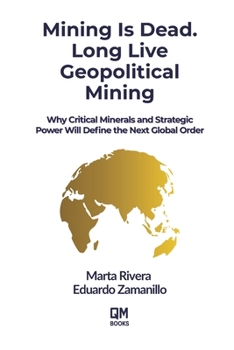
Mining Is Dead. Long Live Geopolitical Mining: Why Critical Minerals and Strategic Power Will Define the Next Global Order

While the West approached mining with a legacy of legalism - a mindset that prioritized process over purpose - China built the future with an engineer's mindset: design the system, build the refineries, secure the supply chains. Guided by long-term vision, it turned critical minerals into industrial and technological sovereignty.
Today, minerals are no longer mere resources - they are the new language of power. From artificial intelligence and clean energy to defense and space, control over lithium, copper, nickel, rare earths, and graphite now defines who leads and who follows.
The West is trying to catch up. Bureaucracy, social-license fatigue, and fragmented regulation have slowed its response, while the real contest - driven by time, not geology - is already underway.
This book examines how China, the United States, and emerging powers are rewriting the mining order: strategic reserves, value-add mandates, sovereign funds, long-term contracts, and alliances that will define the next century of development. Across Africa, Latin America, and Asia, legitimacy and speed now matter more than reserves. It also documents a historic shift in several Western countries, which are beginning to co-invest in critical projects and use state tools to accelerate the midstream and downstream, reducing vulnerabilities.
Geopolitical Mining is not about extraction - it is about transformation. It is the new paradigm for nations that understand that power in the twenty-first century lies not in what they have, but in what they can build.
Customer Reviews
ThriftBooks® and the ThriftBooks® logo are registered trademarks of Thrift Books Global, LLC
