


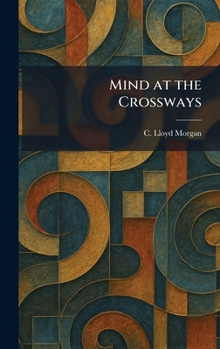
Mind at the Crossways

"Mind at the Crossways" is a profound exploration of the philosophy of emergent evolution by the influential psychologist and philosopher C. Lloyd Morgan. In this work, Morgan examines the intricate relationship between physical processes and mental phenomena, positing that mind is not a mere byproduct of matter but a distinct level of reality that emerges through the evolutionary process. The author navigates the "crossways" where biology, psychology, and metaphysics intersect, providing a systematic framework for understanding how consciousness and purpose arise within the natural world.
Morgan delves into the concepts of causality, guidance, and the progressive development of life, arguing for a worldview that bridges the gap between mechanistic science and teleological philosophy. His clear-eyed analysis addresses fundamental questions of human existence: the nature of the self, the reality of choice, and the place of mind in a cosmos governed by physical laws. This book remains a cornerstone for readers interested in the history of evolutionary thought, the philosophy of mind, and the early foundations of comparative psychology. "Mind at the Crossways" offers a compelling vision of a unified reality where life and mind are integral components of an unfolding universe.
This work has been selected by scholars as being culturally important, and is part of the knowledge base of civilization as we know it. This work was reproduced from the original artifact, and remains as true to the original work as possible. Therefore, you may see the original copyright references, library stamps (as most of these works have been housed in our most important libraries around the world), and other notations in the work.
This work is in the public domain in the United States of America, and possibly other nations. Within the United States, you may freely copy and distribute this work, as no entity (individual or corporate) has a copyright on the body of the work.
As a reproduction of a historical artifact, this work may contain missing or blurred pages, poor pictures, errant marks, etc. Scholars believe, and we concur, that this work is important enough to be preserved, reproduced, and made generally available to the public. We appreciate your support of the preservation process, and thank you for being an important part of keeping this knowledge alive and relevant.
Related Subjects
Philosophy Psychology Science Science & Math Science & Scientists Science & TechnologyCustomer Reviews
ThriftBooks ® and the ThriftBooks ® logo are registered trademarks of Thrift Books Global, LLC
