


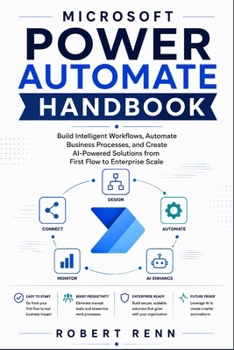
MICROSOFT POWER AUTOMATE HANDBOOK: Build Intelligent Workflows, Automate Business Processes, and Create AI-Powered Solutions from First Flow to Enterprise Scale.

Repetitive work is everywhere: emails that need to be processed, files that need to be moved, information that must be entered into multiple systems, approvals waiting for attention, and business processes that depend on manual coordination.
Microsoft Power Automate provides a way to connect these tasks, systems, and decisions through automated workflows. But effective automation involves more than dragging actions onto a canvas. It requires an understanding of triggers, data, connectors, logic, errors, approvals, security, licensing, and the processes being automated.
Microsoft Power Automate Handbook takes a practical journey from the foundations of workflow automation to intelligent automation and enterprise governance.
The book explores cloud flows, desktop flows, connectors, JSON, expressions, variables, conditions, loops, error handling, testing, approvals, escalation, robotic process automation, AI prompts, AI Builder, and agent flows. It also covers environments, solutions, deployment pipelines, data loss prevention, monitoring, ownership, documentation, and the Center of Excellence.
Realistic business scenarios bring the concepts into context across finance, legal services, property management, manufacturing, healthcare, insurance, recruitment, and other operational environments.
Throughout the book, the focus remains on the thinking behind automation: deciding what deserves automation, choosing the right approach, moving data reliably between systems, handling exceptions, keeping people involved where judgment matters, and treating workflows as managed business assets rather than isolated experiments.
For business professionals, analysts, citizen developers, IT professionals, consultants, freelancers, and Power Platform users, Microsoft Power Automate Handbook presents a structured look at the technology and practices behind modern workflow automation.
From the first trigger to intelligent workflows and governed automation, explore the tools, techniques, and architecture behind Microsoft Power Automate.
Customer Reviews
ThriftBooks ® and the ThriftBooks ® logo are registered trademarks of Thrift Books Global, LLC
