


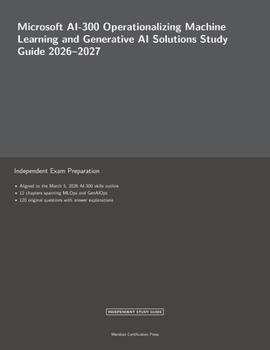
Microsoft AI-300 Operationalizing Machine Learning and Generative AI Solutions Study Guide 2026-2027
No Customer Reviews

Prepare for Exam AI-300: Operationalizing Machine Learning and Generative AI Solutions with an independent study guide organized around Microsoft's skills-measured outline updated March 5, 2026. The guide maps the published domains and weights to 12 chapters and follows the operational lifecycle connecting Azure Machine Learning, Microsoft Foundry, infrastructure as code, model lifecycle management, generative AI quality assurance, observability, and optimization. Official objectives are assigned to owning chapters and supported by original instruction, decision rules, worked scenarios, key concepts, exam tips, source maps, and memory aids. The opening chapters establish Azure Machine Learning workspace foundations: workspace lifecycle, datastores, compute targets, identity and access, reusable data assets, environments, components, and registries. Secure infrastructure-as-code coverage includes GitHub integration, Bicep, Azure CLI, GitHub Actions, restricted network access, and Git-based source management. The guide distinguishes authentication, authorization, network reachability, runtime configuration, data access, and compute capacity so scenario questions can be analyzed at the relevant operational layer. The machine learning lifecycle section covers MLflow tracking, automated machine learning, notebooks, hyperparameter tuning, repeatable training scripts, distributed training, pipelines, cross-job comparison, and feature-retrieval contracts. It then addresses MLflow model registration, responsible evaluation, model-version governance, real-time and batch managed inference, endpoint testing, progressive rollout, rollback, production monitoring, data drift, performance evidence, alerting, and retraining triggers. The GenAIOps chapters examine Microsoft Foundry resources and projects, managed identities, RBAC, private networking, Bicep and Azure CLI deployment, foundation-model selection, serverless and managed compute choices, versioning, release strategy, and provisioned throughput. Prompt lifecycle coverage includes prompt design, controlled variant comparison, Git-based version control, test-data mapping, multidimensional quality measures, safety evaluation, and automated evaluation workflows. Observability coverage distinguishes component latency from end-to-end response time and connects metrics, traces, structured logs, token consumption, resource cost, deployment identity, and production debugging. Advanced coverage addresses retrieval-augmented generation and model customization: chunking and retrieval variables, embedding selection, hybrid search, retrieval measures, controlled RAG experiments, fine-tuning design, synthetic-data governance, customized-model monitoring, and lifecycle operations. The guide treats groundedness, relevance, coherence, fluency, safety, application correctness, latency, throughput, reliability, and cost as distinct dimensions requiring explicit evidence. A 120-question original practice examination is followed by answer explanations and option-by-option rationales. A consolidated mnemonic review, exam quick reference, evidence-based test-preparation guidance, eight-week and four-week plans, a fourteen-day intensive schedule, readiness checks, glossary, references, and subject index support review at different time horizons. The guide recommends retrieval practice, spaced study, mixed practice, error logging, and realistic timed simulation. This publication is an independent preparation resource. It is not affiliated with, authorized by, sponsored by, or endorsed by Microsoft, and it does not use recalled, copied, or purported live examination items. Because Microsoft may revise the outline, candidates should confirm the current official study guide before scheduling the examination or making final preparation decisions.
Format:Paperback
Language:English
ISBN:B0HGRW3ZLL
ISBN13:9798259507197
Release Date:April 2027
Publisher:Meridian Certification Press
Length:200 Pages
Weight:1.40 lbs.
Dimensions:0.5" x 8.5" x 11.0"
Customer Reviews
0 rating
Copyright © 2026 Thriftbooks.com
Terms of Use | Privacy Policy | Do Not Sell/Share My Personal Information | Cookie Notice | Cookie Preferences | Accessibility Statement
ThriftBooks ® and the ThriftBooks ® logo are registered trademarks of Thrift Books Global, LLC
ThriftBooks ® and the ThriftBooks ® logo are registered trademarks of Thrift Books Global, LLC
