


Microelectronic Materials


Select Format
Select Condition 
Book Overview
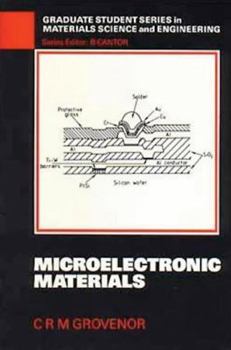
This practical book shows how an understanding of structure, thermodynamics, and electrical properties can explain some of the choices of materials used in microelectronics, and can assist in the design of new materials for specific applications. It emphasizes the importance of the phase chemistry of semiconductor and metal systems for ensuring the long-term stability of new devices. The book discusses single-crystal and polycrystalline silicon, aluminium- and gold-based metallisation schemes, packaging semiconductor devices, failure analysis, and the suitability of various materials for optoelectronic devices and solar cells.
Format:Paperback
Language:English
ISBN:0852742703
ISBN13:9780852742709
Release Date:January 1989
Publisher:Routledge
Length:544 Pages
Weight:1.70 lbs.
Dimensions:1.2" x 6.2" x 9.3"
Customer Reviews
1 rating
very compehensive, but somewhat outdated
Published by Thriftbooks.com User , 25 years ago
This book is about materials used in silicon integrated circuit technology, and about the problems and issues related to each individual material. Although it covers some basic physics of semiconductor devices, including optoelectronic devices (LEDs) and solar cells, 70% of the book is about growth of silicon (bulk crystals and thin films), metallization (i.e., interconnect technology), deposition of insulating films, and packaging. I read several chapters which I was most interested in, and was very satisfied - it was a very rewarding, informative, and time-efficient reading. C.R.M.Grovenor has indeed made a great job of presenting the material and selecting illustrations in this very good textbook, useful for readers with any background in materials science. The only reason why I rated it "4 stars" is that semiconductor industry has changed a lot since this book was published in 1989. While the fundamental science-related chapters are not affected that much, the technologically-oriented parts do not reflect state-of-the-art technology anymore. Therefore it is helpful to have an overall idea what technology and materials are used now to distinguish the data which is still relevant from that which is outdated. Just to give a few examples, metallization technology is confined in this book to aluminum only (there is no mentioning of copper metallization which is now taking over); 30 nm SiO_2 layers are called "very thin" (now "very thin" is less than 3-4 nm); dendritic web and EFG polycrystalline silicon solar cells are quoted to have an efficiency of less than 1% (presently it is 12-15% for the same materials), etc. Despite all this, I am sure that this book deserves attention of materials science students. It was a very good book when it was published, and it is still good, although it requires a critical attitude.
Copyright © 2026 Thriftbooks.com
Terms of Use | Privacy Policy | Do Not Sell/Share My Personal Information | Cookie Policy | Cookie Preferences | Accessibility Statement
ThriftBooks ® and the ThriftBooks ® logo are registered trademarks of Thrift Books Global, LLC
ThriftBooks ® and the ThriftBooks ® logo are registered trademarks of Thrift Books Global, LLC
