


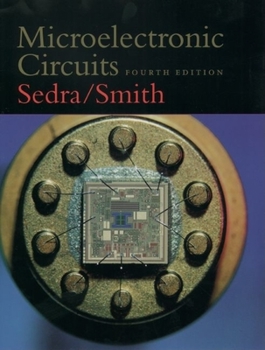
Microelectronic Circuits (The ^AOxford Series in Electrical and Computer Engineering)

Select Format
Select Condition 
Book Overview
Microelectronic Circuits, Fourth Edition is an extensive revision of the classic text by Adel S. Sedra and K. C. Smith. The primary objective of this text remains the development of the student's ability to analyze and design electronic circuits, both analog and digital, discrete and integrated. Fundamental developments in modern technology, particularly the increased emphasis on integrated circuits and the profusion of advances in digital electronics, require that engineers today be aptly equipped with knowledge of these concepts and techniques. In this edition, the authors present these concepts and techniques earlier on in the text and in greater detail than in previous editions.
Features
A Digital Electronics Emphasis
This edition fully integrates the fundamental concepts of digital electronics into the first five chapters, and also devotes two complete chapters (13 and 14) to digital electronics at the end of the text. These provide a complete introduction to both analog and digital principles for a modern introductory course on microelectronic circuits.
The MOSFET
The material on MOSFET has been entirely rewritten to reflect the shift toward integrated circuit technology and the vast number of changes in MOS IC design.
Device Physics...Just in Time
Sedra/Smith integrates device physics into the chapters as needed and where appropriate.
SPICE: Not just how, but why and when
SPICE has been incorporated not only at the end of the appropriate device chapters, but also at the end of most chapters throughout the text.
A Complete Support Package
New CD Now with KC's Problems and Solutions, which contains 600 problems and solutions for student practice. Also includes Interactive Examples, EDN Design Ideas, and Electronics Workbench Multisim 6, with 30 demo circuits and 100 additional circuits for use with the full or student versions. The CD runs on Windows with minimal memory requirements. ** World Wide Web site http: //www.sedrasmith.org with: * SPICE Models * Component Data Sheets * Worked examples with problem-solving hints * Free, downloadable circuits that use Electronics Workbench * Links to industry and academic sites of related interest
** SPICE, 2/e by Gordon Roberts and Adel Sedra (0-19-510842-6)
** Instructor's Manual with Transparency Masters (0-19-511769-7)
** Two-color Transparency Masters of 200 selected figures from the text (0-19-511770-0)
** KC's Problems and Solutions for Microelectronic Circuits, 4/e, by KC Smith (0-19-511771-9)
** Laboratory Explorations for Microelectronic Circuits, 4/e, by KC Smith (0-19-511772-7)
** PowerPoint Overheads available on CD-ROM (0-19-513980-1)and online at www.sedrasmith.org
Features
A Digital Electronics Emphasis
This edition fully integrates the fundamental concepts of digital electronics into the first five chapters, and also devotes two complete chapters (13 and 14) to digital electronics at the end of the text. These provide a complete introduction to both analog and digital principles for a modern introductory course on microelectronic circuits.
The MOSFET
The material on MOSFET has been entirely rewritten to reflect the shift toward integrated circuit technology and the vast number of changes in MOS IC design.
Device Physics...Just in Time
Sedra/Smith integrates device physics into the chapters as needed and where appropriate.
SPICE: Not just how, but why and when
SPICE has been incorporated not only at the end of the appropriate device chapters, but also at the end of most chapters throughout the text.
A Complete Support Package
New CD Now with KC's Problems and Solutions, which contains 600 problems and solutions for student practice. Also includes Interactive Examples, EDN Design Ideas, and Electronics Workbench Multisim 6, with 30 demo circuits and 100 additional circuits for use with the full or student versions. The CD runs on Windows with minimal memory requirements. ** World Wide Web site http: //www.sedrasmith.org with: * SPICE Models * Component Data Sheets * Worked examples with problem-solving hints * Free, downloadable circuits that use Electronics Workbench * Links to industry and academic sites of related interest
** SPICE, 2/e by Gordon Roberts and Adel Sedra (0-19-510842-6)
** Instructor's Manual with Transparency Masters (0-19-511769-7)
** Two-color Transparency Masters of 200 selected figures from the text (0-19-511770-0)
** KC's Problems and Solutions for Microelectronic Circuits, 4/e, by KC Smith (0-19-511771-9)
** Laboratory Explorations for Microelectronic Circuits, 4/e, by KC Smith (0-19-511772-7)
** PowerPoint Overheads available on CD-ROM (0-19-513980-1)and online at www.sedrasmith.org
Format:Hardcover
Language:English
ISBN:0195116631
ISBN13:9780195116632
Release Date:June 1997
Publisher:Oxford University Press
Length:1360 Pages
Weight:5.10 lbs.
Dimensions:7.9" x 2.1" x 9.6"
Customer Reviews
4 ratings
The Bible of Electronics
Published by Thriftbooks.com User , 22 years ago
This book is all you need: If you want insight into the field of electronics as a hobbyist, technician or a professional engineer, this book is for you. It has complete coverage of basic electronic devices and circuits, analog circuits, and digital circuits. The book can also be used for self-study, but it can be hard to follow straight through since it's really organized more like a reference book than a textbook. If you're thinking about continuing your study of electronics on a more advanced level, this book will give you solid preparation. A word of advice: at some points in the book, the explanations are extremely clear and lucid; at other points the explanations are vague, and always where you least expect it! To get around this, solve as many example problems and exercises as possible, and the "fine points" of the explanations will become crystal clear. As you know, this is true for any engineering discipline, but it seems like the example problems were designed specifically to clarify the occasional "vaguenesses" of the text.
one of the best
Published by Thriftbooks.com User , 24 years ago
This text manages to strike a good balance between theory and practice. Device operation is covered in considerable detail, and so are their applications. When deciding on a rating, I'm comparing this book to Analog IC Design by Grey, Meyer, et.al and to Art of Electronics, by Horowitz and Hill. These two books are considered the best in the field, and Sedra/Smith manage to present the material on the par with these two, but give more device operation theory than Horowitz/Hill and somewhat more applications then Grey/Meyer. Personally, I like all 3 books and have them all. And for people who give bad reviews due to lack of spice integration, typos, and other minor nuances: no book is ever perfect. For example, Grey/Meyer don't cover MOSFET analog switches, while Horowitz/Hill barely go into device operation at all -- they just give rough equations and rule-of-thumb tips. Yet these two books are still considered great. I think Sedra/Smith wrote a book on the par with industry standard texts.I, for one, was able to skip lectures given by my incoherent prof. and learn solely from this book.
Wonderful Book! Both for study and reference
Published by Thriftbooks.com User , 26 years ago
Sounds very funny. All the American readers gave this book high evaluation but the only Canadian reader gave a poor evaluation even this book were written by Canadian professors. As for me, a person who had done graduate studies in US but now moved to Canada may also give an evaluation. I think this is REALLY a wonderful book. When I was a student in Arizona, I studied this book and many stuffs had actually helped me during my job interviews both in states and Canada and helped me get multiple offers! Now I've already been a professional engineer and still feel this is a very good reference book. It should be a "Bible" for all the EE students and engineers, I think.
The MOST luminous introductory text written to date.
Published by Thriftbooks.com User , 26 years ago
I have NEVER encountered a text used in an intro or advanced semiconductor course that explains the materials that Sedra and Smith covers with such immense clarity and fluidity. I graduated in 1996 in Electrical Engineering from Iowa State University (ISU) and still admire and DEEPLY love the authors' writing abilities. If I could, I would give them three thumbs up for their achievement. Their elegance of simplicity have launched many of my friends and I into very fruitful careers in the semiconductor field (e.g., with Compac Alpha Development Group, Burr-Brown Corporation, Cadence Design Systems, TI, Analog Devices, and Intel). No other text in the market is quite as luminous. And who cares if Canadian or European schools are somewhat better than the U.S. That's IRRELEVANT to your learning progress. It PRIMARILY depends on the student and his/her extreme passion to learn. Take a good look at Bob Noyce, Co-Founder of Intel (a son of a Pastor from Iowa), or Hewlett and Packard...et cetera...It only took me one week to read the textbook. You know the textbook taught you well (instilled circuit intuition) when you are held in HIGHER regard than the PhD in Microwave Engineering or the student who graduated from MIT with a 3.99 GPA, at an interview with Burr-Brown Corporation (Tucson, AZ). Think about them apples for a while.Disregard all the immature remarks you've read.
Copyright © 2026 Thriftbooks.com Terms of Use
| Privacy Policy | Do Not
Sell/Share My Personal Information | Cookie Policy | Cookie Preferences | Accessibility Statement
ThriftBooks® and the ThriftBooks® logo are registered trademarks of Thrift Books Global, LLC
ThriftBooks® and the ThriftBooks® logo are registered trademarks of Thrift Books Global, LLC
