


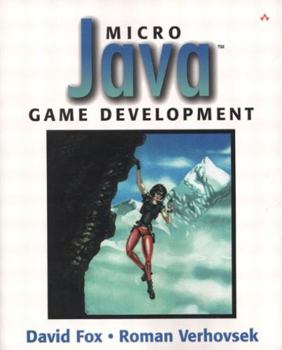
Micro Java(tm) Game Development


Micro Java Games Development explains game development for devices that support J2ME MIDP. The six parts cover a full range of topics, from a tour of all available micro-devices (Palms, cell phones and pagers), a discussion of software standards apart from J2ME (cell phones, messaging, I-mode and wireless enhancements such as Bluetooth), and available J2ME extensions (Siemans, Ericcson, Nokia), development tools and restrictions, to the creation of a meaty J2ME game!
Format:Paperback
Language:English
ISBN:0672323427
ISBN13:9780672323423
Release Date:April 2002
Publisher:Addison-Wesley Professional
Length:576 Pages
Weight:2.00 lbs.
Dimensions:1.3" x 7.4" x 9.1"
Customer Reviews
5 ratings
Good introduction
Published by Thriftbooks.com User , 23 years ago
Good introduction to both game development and j2me overview and programming. Good examples you can relate to.
Great book for beginning MIDP game developers
Published by Thriftbooks.com User , 23 years ago
I have a number of J2ME/MIDP books but none of them cover game building with MIDP other than very basic games. This book goes into some of the real issues of developing a graphical based realtime game. If you are looking to build a game with MIDP and have no gaming experience this is a very good book to get you started.
A Good Starting Point
Published by Thriftbooks.com User , 23 years ago
This book is the first I have read on Micro Game Development. I have recently looked into the subject for my Final Year Project, and found that there are lots of tools, standards and SDK's etc. to get your head round. The information on Sun Microsystems and Nokias sites is vast, and is going to take weeks to correlate. This book covers most of the things I need to initially know to get started in mobile game development.The book starts with a brief explanation about the history of computer games and how they have changed over the years along side growing technology. An overview of the books mission helps to imprint what the book is going to teach you. This has helped me understand the overall structure of the subject.If you are new to gaming the book explains some of the basics of game design but later goes into more detail, including choosing genres that are more suited small devices.The first part of the book explains small devices on a wider scale. Different Java enabled devices are described such as PDA's Set Top Boxes and Smart Cards etc. this puts mobile game programming in perspective to the overall structure of small device programming.Java has a number of add-ons which cater for these different devices, such as JavaTV for set top boxes and j2me PDA profile for PDA's. These technologies are briefly described along with MIDP and CLDC which are specific to mobile phones, to give an overview of the different development environments of small devices. Part two goes into mobile phone technologies in more detail, explanations include first, second, second and a half and third generation phones, as well as SMS, MMS, WAP and WML etc.Part three starts to get into the meat of mobile phone technology, J2me. It describes the need for a cut down version of Java, and ex[plains the structure of j2me, CLDC, MIDP on mobile phones.This part also walks through the writing, compiling and deploying of a simple miDLET using the command line and the `Wireless Tool Kit'. It then goes into simple procedures such as displaying graphics and command listening. Threads, code size reduction and memory optimisation is also covered.The game side of the book really begins in part four. High and Low level GUI's are discussed, before moving onto sprites and their management. Audio and Networking is also discussed here.Part five describes some j2me extensions such as PersonalJava, CDC and the Siemens Game API.The most exciting part of the book however is part six which walks through the creation of a racing game. This gives the necessary code along side explanations to develop a small game.This book overall, is a good starting point into the understanding Micro Game Development and is also an enjoyable read. I would recommend it to anyone who is considering moving into this area, and wants to take a quick look first.There are a few downsides to the book though, there are plenty of typo's which I also noticed in an article by one of the authors. Also the book is now a year o
Excellent book
Published by Thriftbooks.com User , 24 years ago
I started reading this book, because I did not see any other good options around. Probably it is the first book on game programming in J2ME. Other books are limited to either games or J2Me. I read the book and found it very useful. Even if you are new to all this, you will not have trouble with this book (assuming familiarity with Java). This book is divided into 6 main sections. The book starts with an introduction to the java enabled mobile devices. Thus, if you are new in the field, the sections might be very useful. Else you can easily skip over to J2ME section. The authors discuss some available programming tools and then describe programming techniques for using less memory, optimization and multithreaded programming.Part 4 of the book is the real core about game programming. The book covers development of Graphical User Interfaces, Audio basics and wireless networking. It does an excellent job in explaining the mechanics of game programming. The working can be understood even if you are not a J2ME guru. In latter parts, they cover personal java APIs, iAppLi, Siemens Game API. You will learn neat stuff about accessing Phone Books, making calls, sending SMS messages etc. At end, they put together all tricks to develop the micro-racer game. A nice project to learn it all. Highly recommended for readers of Beginner/Intermediate level in areas of game programming and J2ME.
High-quality, thorough, well-written... with a few flaws
Published by Thriftbooks.com User , 24 years ago
Great book! Some highlights:- well written- good level of detail - not too wordy, yet clear and descriptive- forward-thinking - hits on many important, yet frequently overlooked topics like future market outlook, related industry initiatives, publishing options, third party extensions and APIs, available devices, etc. This includes information from around the world, not just US.- includes a thorough listing/overview of existing games in the marketplace that the author considers to be top of the crop. I found this extremely helpful, both as a guide for setting my level of expectation and as a real life view on what's out there, what works, what's popular, what's missing, etc.- highlights the importance of good game design, playtesting, preproduction. This is a real guide to game development, not just a J2ME programming primer.- a full-blown game, with networking support and all, is created during the course of the book.5/23/02 - An update, having gone through about 60% of the book:Most of my expectations (as described above) were met and even exceeded in many cases, however, there are also a couple of minuses to the book:1. There is a large amount of typos, some fairly serious (read: in the source code). This can take you off track every once in a while as you try and fail to align the text and the code in your head.2. As there is no CD with the book, you have to re-type all the code yourself if you want to use it. Of couse, given the typos, that's probably a good thing. I emailed the publisher about being able to download the code from the web, no response yet.3. Some of the code is not as well commented/explained as it could be, and assumes a higher level of expertise with Java that one would initially think. You should be quite comfortable with most aspects of J2SE, especially Swing and Threads in order to navigate through the code smoothly.Because of these, keeping the rating at 4 stars. Still, it's a great book, and a highly recommended read if you are interested in J2ME, games, or both.
Copyright © 2026 Thriftbooks.com
Terms of Use | Privacy Policy | Do Not Sell/Share My Personal Information | Cookie Notice | Cookie Preferences | Accessibility Statement
ThriftBooks ® and the ThriftBooks ® logo are registered trademarks of Thrift Books Global, LLC
ThriftBooks ® and the ThriftBooks ® logo are registered trademarks of Thrift Books Global, LLC
