


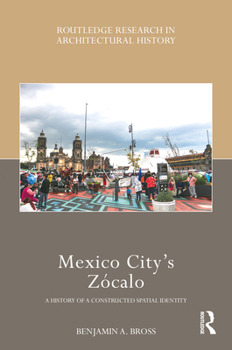
Mexico City's Zócalo: A History of a Constructed Spatial Identity

This book presents a case study of one of Latin America's most important and symbolic spaces, the Z calo in Mexico City, weaving together historic events and corresponding morphological changes in the urban environment. It poses questions about how the identity of a place emerges, how it evolves and, why does it change? Mexico City's Z calo: A History of a Constructed Spatial Identity utilizes the history of a specific place, the Z calo (Plaza de la Constituci n), to explain the emergence and evolution of Mexican identities over time.
Starting from the pre-Hispanic period to present day, the work illustrates how the Z calo reveals spatial manifestations as part of the larger socio-cultural zeitgeist. By focusing on the history of changes in spatial production - what Henri Lefebvre calls society's "secretions" - Bross traces how cultural, social, economic, and political forces shaped the Z calo's spatial identity and, in turn, how the Z calo shaped and fostered new identities in return. It will be a fascinating read for architectural and urban historians investigating Latin America.
Customer Reviews
ThriftBooks ® and the ThriftBooks ® logo are registered trademarks of Thrift Books Global, LLC
