


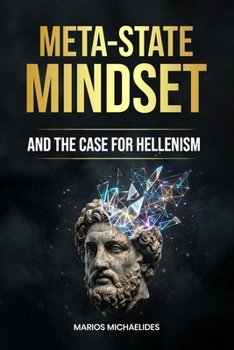
Meta-State Mindset: And the Case for Hellenism

In an era of resurgent identity politics, failing nation-states, and global migration, how can an ancient people without a truly sovereign homeland preserve and strengthen their civilisation? The Meta-State offers a bold, original answer: a bottom-up, decentralised framework that transcends traditional borders while remaining fiercely rooted in shared culture, memory, and purpose.
Focused on the Hellenic nation, this groundbreaking socio-political study proposes the Meta-State as a revolutionary organising principle for ethnic nations in the twenty-first century. Neither a nostalgic fantasy of return nor a surrender to assimilation, the Meta-State is a practical, adaptable architecture that enables a people to thrive politically, culturally, and economically even when scattered across dozens of countries and inadequately represented (or actively misrepresented) by the nation-states in which they live. Drawing on history, political philosophy and real-world examples, the book systematically examines the dimensions of nationhood: The religious and metaphysical foundations of Hellenic identityLanguage preservation and evolution in a diaspora contextEconomic co-operation, investment pools, and transnational business networksEducation, media, and the creation of shared informational ecosystemsDiplomatic strategies and soft-power projection without centralised state powerAt its core, The Meta-State argues that the nation-state model is increasingly obsolete for many historic peoples. In its place, the author presents a viable alternative: a distributed, resilient, self-organising civilisation that operates above, below, and across existing states. The Meta-State does not seek to replace countries, but to complement them, building parallel structures that can advocate for national interests more effectively than overburdened or compromised national governments.
Customer Reviews
ThriftBooks ® and the ThriftBooks ® logo are registered trademarks of Thrift Books Global, LLC
