


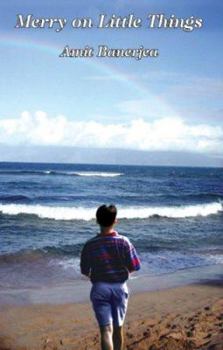
Merry on Little Things

No Synopsis Available.
Format:Paperback
Language:English
ISBN:1410798216
ISBN13:9781410798213
Release Date:March 2004
Publisher:1st Book Library
Length:184 Pages
Weight:0.45 lbs.
Dimensions:0.4" x 5.0" x 8.0"
Customer Reviews
4 ratings
Sensitive and moving
Published by Thriftbooks.com User , 20 years ago
Reviewed by Linda Benninghoff for Reader Views (5/06) This captivating memoir tells the story of the author's childhood in India. Sections of it also portray his experience of Diaspora--being an immigrant living in the U.S. The book begins with leave-takings. The family moves from East Bengal to Calcutta, where the father has taken a government post. The author is poor but always has enough to eat and houses to live in--complex houses with verandahs. The houses are described in great detail. The memoir is made up of a series of anecdotes. Intricately written, it intersperses his past in India and future in the U.S. The author paints a compelling picture of an Indian boyhood and, in passing, gives some history of the country and teaches about Indian culture. Banerjea often uses Indian words, and describes in detail some of the religious rituals. He states that Muslims and Hindus got along well prior to the division of the country into India and Pakistan, after independence. It was then that religious tensions rose. He tells the story of a Hindu man who, all his life, devoted himself to the Muslims in his village. Then, after the division of the country, they betrayed him. Although the book focuses mainly on the author's Indian childhood, it also attempts to capture the experience of Diaspora: "In the last century, millions of multinational and ethnic groups from various parts of the world came as displaced persons or as refugees, or immigrated, or worked as expatriates in new and foreign lands, and they became diasporic populations. Each of these people has his or her own diasporic experience which is unique and heartfelt." I sensed how much the author missed his childhood home and family. While he is in Flushing, he manages to gather other Hindus together into a cultural-social enclave. This helps him feel less misplaced and helps him preserve his Indian roots. The characters are drawn with careful brushstrokes. As I read, I felt I got to know them well. In one of the many stories, he gives a moving picture of his grandmother, Thakuma, who is widowed at an early age and defies tradition, bringing up her son by herself in her husband's house. "She was a very disciplined woman. She did all her work routinely, she did her own cooking, and she had a separate chulla, which she lit herself when she did the cooking. She boiled her own land-grown rice, husked on dredi, producing brown rice which gave a superb aroma when cooked!" Thakuma's strength and independence emerge from the description. I felt the author aimed high with this work and, for the most part, achieved his goal. I was moved by the little boy falling down in the strange streets of Calcutta after having gone outside while his mother was napping, still too young to be out on his own. One of the remarkable things about this book is its focus on people--family, friends, and playmates. When he describes kite-flying with a playmate, I remember my own games a
A memoir of great promise
Published by Thriftbooks.com User , 21 years ago
Amit Banerjea will get your attention at the opening of "Merry on Little Things." His father has moved the family to Calcutta and Banerjea describes their new home in the eyes of a little boy. Here's how the houses look, with their rail-less verandas and enclosed courtyards. Here's how the family survived, poor, in a city where poverty has levels that know almost no bounds. Amit is told by his mother and father: do not stray outside the building and when he does inevitably disobey, we see the dangers and confusion of life in this city, feeling almost as scared and confused as the little lost boy must have felt. This memoir is far from perfect--the usual speedbumps of too many foreign words make the language a bit halting for those of us not familiar with terms like puja and lahk. However, if you overlook this minor flaw, you will see a writer of GREAT promise who has the ability to delve into memory and senses and produce a work that is bound to touch you. Banerjea's writing reminds me strongly of Ved Mehta--the blind Indian author who wrote a trilogy of biographies (Vedi, Daddyji, Mammaji) that were excerpted in the New Yorker in the 80's. Mehta could take you into his world of sounds, smells, texture and flavor, and Banerjea does that with a masterful hand. In addition, as the author leaves India for England and the US, his writing changes along with the adoption of new English words and slang--his growing sophistication and knowledge is incredibly well reflected in his writing. But the most touching part of Banerjea's memoir is his depiction of the life of widows and women in Indian society. The socialized degradation of widows is explained and more significantly, we cry along with him for the bad things that happen to the women in his life. This is not a perfect book, but it's a sensitively written and heartfelt memoir that had me reading it non-stop from cover to cover. I then immediately rang up the author on the phone. Well done. Write more, please, Mr. Banerjea. Highly recommended.
an intimate look into a rich heritage
Published by Thriftbooks.com User , 21 years ago
The modern Indian Diaspora evolved mainly due to the subjugation of India by the British. Being an ignorant American, I never realized this and I'd been oblivious to it. What a sheltered life we lead. Millions of people were displaced from their ancestral lands, struggling to hold onto their traditions and culture as India was divided. Amit Banerjea shares the story of his life as he grew up in Bengal and Calcutta and his eventual emigration to the United States. The book is full of life and times that are memories of boyhood. Much like any other person holds memories of times, the author relays his thoughts, bringing to life many stories of his childhood. But he also is relaying the culture of India, the traditions of his family and society. In this, he offers an intimate look into a rich heritage. From the simple furnishings of his household to the play of young children, from the family structure and taboos to the much enjoyed reunions with relatives, and the dealings of arranged marriage, Emit details the meanings behind the images and truly opens up a whole new world to readers. You will become immersed in Indian heritage and will come away richer for the experience. The book is delightful to read, full of vivid images and scenes, and plain old life. You will come away from this title appreciating the little things and cherishing the variety of cultures in the world. Review by Heather Froeschl
Wonderful
Published by Thriftbooks.com User , 22 years ago
It is important that books like this is written, books that preserve the history of ways of life which are becoming lost. The book has many touches of humor, very poignant, very real and human. Written very well, fliudly and comprehensively. WONDERFUL.
Copyright © 2026 Thriftbooks.com
Terms of Use | Privacy Policy | Do Not Sell/Share My Personal Information | Cookie Notice | Cookie Preferences | Accessibility Statement
ThriftBooks ® and the ThriftBooks ® logo are registered trademarks of Thrift Books Global, LLC
ThriftBooks ® and the ThriftBooks ® logo are registered trademarks of Thrift Books Global, LLC
