


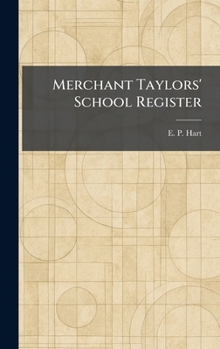
Merchant Taylors' School Register

"Merchant Taylors' School Register 1851-1920" is a comprehensive historical archive and vital genealogical resource documenting the members of one of England's most distinguished educational institutions. Compiled by E.P. Hart, this meticulous volume provides a chronological account of the students and staff who attended or served the school during a pivotal seventy-year period in British history.
The work serves as a primary source for researchers and historians, offering detailed biographical data that tracks the academic and professional trajectories of the school's alumni. From the heights of the Victorian era through the conclusion of the First World War, the register captures a broad spectrum of social and institutional development. Entries often include information regarding enrollment dates, honors, and subsequent careers, providing a clear window into the social fabric and the leadership class of the era.
As a scholarly reference, "Merchant Taylors' School Register 1851-1920" is indispensable for those tracing family lineages or studying the evolution of the British private school system. It stands as a testament to the school's enduring legacy and its role in shaping the professional, military, and civic lives of its pupils throughout the late 19th and early 20th centuries.
This work has been selected by scholars as being culturally important, and is part of the knowledge base of civilization as we know it. This work was reproduced from the original artifact, and remains as true to the original work as possible. Therefore, you may see the original copyright references, library stamps (as most of these works have been housed in our most important libraries around the world), and other notations in the work.
This work is in the public domain in the United States of America, and possibly other nations. Within the United States, you may freely copy and distribute this work, as no entity (individual or corporate) has a copyright on the body of the work.
As a reproduction of a historical artifact, this work may contain missing or blurred pages, poor pictures, errant marks, etc. Scholars believe, and we concur, that this work is important enough to be preserved, reproduced, and made generally available to the public. We appreciate your support of the preservation process, and thank you for being an important part of keeping this knowledge alive and relevant.
Customer Reviews
ThriftBooks ® and the ThriftBooks ® logo are registered trademarks of Thrift Books Global, LLC
