


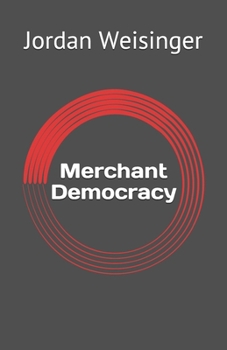
Merchant Democracy
No Customer Reviews

Conventional democracies haven been based on a combination of demographic-based representation and arbitrary representation for thousands of years. It is time for a change. There are other ways an electorate can be engineered that produce high quality democratic entitlements. Econometric representation uses statistics to organize electorates into more efficient and representative units. These innovations in political representation may provide to be more durable and more equitable than prior combinations. Nations can use GDP as a straight representational coefficient basing the number of representatives apportioned on the Gross Domestic Product of the state. This will effectively increase the per capita income for the nation and make it more likely to preserve its democratic entitlements over a longer period. It will also incentivize union formation between mature and developing nations with both nations benefiting from the unionization.Econometric representation also enables nations to utilize a median partition to separate the electorate into an above median GDP chamber and a below median GDP chamber. Both parts of the bicameral legislature will have an equal number of representatives and the total number of representatives will be based on the population of the state. Thus, the median partition preserves universal suffrage and majority rule while improving political discourse by interjecting class rhetoric and policy preferences.
Format:Paperback
Language:English
ISBN:1695019660
ISBN13:9781695019669
Release Date:September 2019
Publisher:Independently Published
Length:82 Pages
Weight:0.25 lbs.
Dimensions:0.2" x 5.5" x 8.5"
Customer Reviews
0 rating
Copyright © 2026 Thriftbooks.com Terms of Use
| Privacy Policy | Do Not
Sell/Share My Personal Information | Cookie Policy | Cookie Preferences | Accessibility Statement
ThriftBooks® and the ThriftBooks® logo are registered trademarks of Thrift Books Global, LLC
ThriftBooks® and the ThriftBooks® logo are registered trademarks of Thrift Books Global, LLC
