
Skip to content
Scan a barcode
Scan
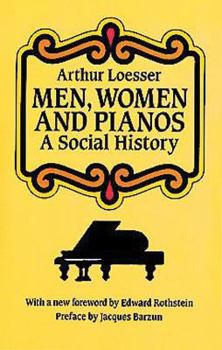
Paperback Men, Women and Pianos: A Social History Book

ISBN: 0486265439

ISBN13: 9780486265438

Men, Women and Pianos: A Social History

Select Format

Select Condition ThriftBooks Help Icon

Recommended

Format: Paperback

Condition: Good

$6.99
Save $17.96!
List Price $24.95
Almost Gone, Only 3 Left!
Save to List

Book Overview

As the "social anchor" in middle-class homes of the nineteenth century, the piano was simultaneously an elegant piece of drawing-room furniture, a sign of bourgeois prosperity, and a means of introducing the young to music. In this admirably balanced and leisurely account of the popular instrument, the late, internationally known concert pianist Arthur Loesser takes a "piano's-eye view" of the recent social history of Western Europe and the United States.
Drawing on newspapers, music manuscripts, popular accounts, and other sources, Loesser traces the history of the piano from its predecessors, the clavichord and the harpsichord, to the modern spinet and concert grand. Chapter headings such as "Clavichords Make Weeping Easier," "The Harpsichord Grows Feet," "The More Pianos the Merrier," and "The Keyboards Go West" suggest the author's lighthearted approach to topics ranging from the piano's European origins and its introduction in the United States to the decline of piano manufacturing in the early twentieth century and the "victory of airborne music" by mid-century. A preface by historian Jacques Barzun and a new foreword by music critic Edward Rothstein enhance a volume rich in wit and knowledge -- one that will delight any reader with an interest in the piano and on Western cultural history.

Customer Reviews

5 ratings

More than a book-it's an adventure

This book is really more than a book, it's an adventure. First of all, it is rather long, so it is not a book to be casually perused. Rather, to read it will require a fairly serious amount of time and concentration. What I find most striking about it is how thorough and in-depth it is. The author clearly went through every piece of literature he could find concerning the piano in the 18th and 19th centuries-brochures, sales records, newspaper articles, concert programs, all in multiple languages- and incorporated it all into his study. The scholarly scope and erudition of the work is staggering. However, it is not annotated. As for the content of the book, we can almost say it is a Marxist analysis of the history of the piano. He mostly discusses the life of the piano and its use in society from the point of view of class differences, as well as from the point of view of means of production and organization of labor. Much of the motivation for the middle classes to own pianos was to emulate the higher classes, he says. In this sense I felt like I was reading Paul Fussell's excellent book "Class." Both books contain a derisive attitude toward the middle classes, depicting them as motivated solely by their desire to appear more high class than they really are, and as not really having their own independent minds, but as being swept away in whatever trend has been recently marketed to them by those who can only make a profit by selling their mass-produced inventory. A final note: Keep a dictionary handy when reading this book. The author's vocabulary is enormous, and he's not afraid to use it.

An entertaining, witty and profound chronicle

Arthur Loesser, pianist, composer and longtime faculty member at the Cleveland Institute of Music, was also a historian and writer of talent, as evidenced by this "social history" he penned in the 1950s. "Men, Women and Pianos" is many things. It is partly a history of the instrument itself: Loesser shows how the desire of musicians for a keyboard instrument more versatile and/or powerful than the existing clavichord, harpsichord and organ led makers in several countries more or less simultaneously to invent the basic action of the piano at the turn of the eighteenth century. It is partly, of course, a history of great pianists and composers and their particular regards and attitudes toward this newfangled contraption. It is partly a history of instrument makers and their innovations, from Bartolomeo Cristofori, who is widely credited with the actual invention of the "pianoforte," to the Steinways, whose instruments still set the standard in piano-making today. Perhaps most important, however, it is a chronicle of the instrument and its relationship to everyday people and society, at times amusing, at times sobering. Along the way Loesser examines questions that may never have occurred to other historians before him, such as how ladies played four-hand music in their enormous hoop-skirts, or how much of the appeal of a third-rate salon piece of the early 1900s called "A Maiden's Prayer," still in print, may have emanated from its title. Summarizing Loesser's work can give but a faint idea of his wide-ranging interests, or the dry humor of his writing. This is a book that appeals even to the non-musician, but which should be required reading for musicians. It ends on a downbeat note in 1954, with piano sales declining in the face of increased competition from electric gadgets such as television and the phonograph. One wonders what Loesser would think of the scene today, with digital technology enabling musical reproduction at speeds and with an ease he never could have imagined. There is a whole other book to be written about what has happened to the keyboard and home music-making since 1954, when Loesser's chronicle ends: one only hopes that whoever finally writes it has a fraction of his erudition, wit, and love of music.

Rare elequence combines with humor

The writing is articulate beyond belief, reflecting the author's fluency in multiple languages, and the thoroughly tongue-in-cheek tone--the "digiterferous bank accounts" of the wealthy--makes it fun to read. And of course there's the story itself, beginning in the era when Democracies were replacing Monarchies, the 18th Century, and ending in the US around the First World War, when the instrument began its abrupt decline, using old newspapers, magazine articles, publishers' catalogs, etc., as sources, translated as needed by the author. We learn of the influential Germans, who nurtured the instrument's development in the beginning, took a back seat to the English and French for a while, then regained the lead in the latter half of the 19th century as they became an industrialized nation, and the origins of Classical music--that is, the performance of dead composers' works--which replaced the usual practice of concert performers playing variations of well-known grand opera tunes when that died out as Liszt and others fled for their lives during the Second French Revolution of 1848. The story ends in the US. In the later 19th Century, the piano was the focus for entertainment in the Victorian home and popular sheet music sold millions of copies--but changing culture, as much as technology, soon doomed the instrument. In all, a tale of music's role in modern Western society told effortlessly by someone who's spent a lifetime gathering the facts.

A bravura performance!

If you love music, especially that of the piano, then you should definitely make room on your musical bookshelf for this wonderful and comprehensive book. The author, Arthur Loesser, was a well-known concert pianist who was also a gifted writer, critic and annotator--shades of that earlier duallist, Berlioz! This dandy, thick book, detailing the history of keyboards, also includes many of the personalities involved in music-making through the centuries. The hard-cover edition--originally published in 1954--is long out of print, making this trade-paper version even more welcome. Once it's yours, you'll be in possession of nearly everything you ever wanted to know about these keyboard instruments--and then some! And, once you begin reading, you'll find it difficult to put it aside, even for a moment.Each major country had its own beginnings with music and the keyboards that brought that music to life. This book is, therefore, a geographical as well as a musical tour. Beginning in about the mid-1500s and continuing to more recent times, Loesser informs us of the musical progression in Germany, Austria, England, France, and finally the US. Whether you begin with the English in the 1500s or the Germans in the 1600s or the French in the 1700s, you'll be intrigued by the variety of instruments unveiled in these pages for your delectation, as well as his humorous side trips into more human endeavors. (There's an entire chapter [Section Three, Chapter Eighteen] on the use of music in the novels of Jane Austen, for example.) Loesser skillfully utilizes his dry and frequently wry wit in detailing the history and usage of keyboard instruments, as well as those who merely were the players of them. It's quite obvious that, to Mr. Loesser, the instruments themselves were the more worthy, and he skillfully educates the reader in the evolution of today's piano, including the advantage gained by the availability of steel framing. There are many types of keyboard instruments, some more well-known than others, but none are slighted in this comprehensive retrospective. In addition, social history is also brought into prominence, as well as those artisans who have moved us with their performances. Another bravura performance from this noted musician.

It's all here

When it comes to the history of the piano, if it's not in this book, you don't need to know it. Loesser writes this "biography" of the piano with accuracy, detail, plenty of anecdotes, good judgment, and an abundance of humor. You'll be hooked after a few lively chapters--even if you thought you had only a passing interest the pianoforte.
Copyright © 2026 Thriftbooks.com Terms of Use | Privacy Policy | Do Not Sell/Share My Personal Information | Cookie Policy | Cookie Preferences | Accessibility Statement
ThriftBooks® and the ThriftBooks® logo are registered trademarks of Thrift Books Global, LLC

GoDaddy Verified and Secured