


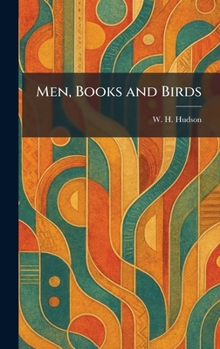
Men, Books and Birds

Select Format
Select Condition 
Book Overview
"Men, Books and Birds" is an illuminating collection of personal correspondence from the celebrated naturalist and author W. H. Hudson to his close friend, Morley Roberts. This work offers a rare and intimate perspective on the life and thoughts of a man who dedicated his existence to the observation of the natural world and the pursuit of literary excellence. Through these letters, readers are invited into Hudson's private world, where his profound love for birds and his sharp intellect come to the forefront.
The collection spans a wide array of topics, ranging from detailed ornithological observations and reflections on the English countryside to candid critiques of contemporary literature and philosophical musings on the human condition. Hudson's prose is characterized by its clarity and deep sensitivity, capturing the fleeting beauty of the wild and the complexities of the creative mind. Edited with insightful notes by Morley Roberts, "Men, Books and Birds" serves as both a testament to a lifelong friendship and an essential document for understanding one of the most significant figures in the tradition of English nature writing. It is a compelling read for those interested in the intersections of science, literature, and the art of the letter.
This work has been selected by scholars as being culturally important, and is part of the knowledge base of civilization as we know it. This work was reproduced from the original artifact, and remains as true to the original work as possible. Therefore, you may see the original copyright references, library stamps (as most of these works have been housed in our most important libraries around the world), and other notations in the work.
This work is in the public domain in the United States of America, and possibly other nations. Within the United States, you may freely copy and distribute this work, as no entity (individual or corporate) has a copyright on the body of the work.
As a reproduction of a historical artifact, this work may contain missing or blurred pages, poor pictures, errant marks, etc. Scholars believe, and we concur, that this work is important enough to be preserved, reproduced, and made generally available to the public. We appreciate your support of the preservation process, and thank you for being an important part of keeping this knowledge alive and relevant.
Customer Reviews
ThriftBooks ® and the ThriftBooks ® logo are registered trademarks of Thrift Books Global, LLC
