


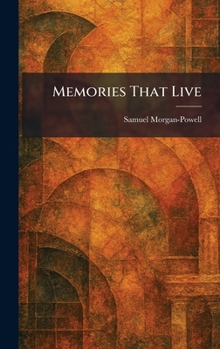
Memories That Live

Select Format
Select Condition 
Book Overview
"Memories That Live" is an evocative collection of reminiscences by the esteemed Canadian journalist and critic Samuel Morgan-Powell. As a prominent voice in the literary and theatrical world of the early twentieth century, Morgan-Powell provides a firsthand account of the cultural developments that shaped North America. The work delves into the author's encounters with legendary figures of the stage and the page, offering a vivid tapestry of anecdotes that bridge the gap between journalism and literature.
Through these pages, readers gain insight into the evolution of Canadian culture and the intellectual vibrancy of an era marked by rapid change. The narrative explores the art of criticism, the magic of the theater, and the enduring power of literary pursuit. Morgan-Powell's prose is both reflective and sharp, capturing the spirit of a dedicated observer of human talent and creativity. This volume stands as a significant historical document for those interested in the history of Canadian letters, the theatrical traditions of the past, and the life of a man who stood at the intersection of public reporting and private reflection. "Memories That Live" is a testament to the enduring nature of artistic memory and the vital role of the critic in chronicling their time.
This work has been selected by scholars as being culturally important, and is part of the knowledge base of civilization as we know it. This work was reproduced from the original artifact, and remains as true to the original work as possible. Therefore, you may see the original copyright references, library stamps (as most of these works have been housed in our most important libraries around the world), and other notations in the work.
This work is in the public domain in the United States of America, and possibly other nations. Within the United States, you may freely copy and distribute this work, as no entity (individual or corporate) has a copyright on the body of the work.
As a reproduction of a historical artifact, this work may contain missing or blurred pages, poor pictures, errant marks, etc. Scholars believe, and we concur, that this work is important enough to be preserved, reproduced, and made generally available to the public. We appreciate your support of the preservation process, and thank you for being an important part of keeping this knowledge alive and relevant.
Customer Reviews
ThriftBooks ® and the ThriftBooks ® logo are registered trademarks of Thrift Books Global, LLC
