


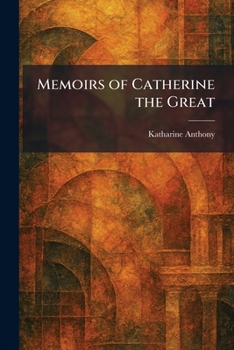
Memoirs of Catherine the Great

Select Format
Select Condition 
Book Overview
"Memoirs of Catherine the Great" offers an intimate and compelling look into the early life and political ascent of one of history's most formidable female rulers. Written by Catherine II herself, these memoirs provide a rare first-hand perspective on her journey from a minor German princess to the Empress of all the Russias. The narrative details her complex relationship with her husband, Grand Duke Peter III, the intrigues of the Russian court under Empress Elizabeth, and the intellectual growth that would eventually characterize her reign as an enlightened despot.
Within these pages, the reader finds a woman of extraordinary ambition, intelligence, and resilience. Catherine reflects on the challenges of adapting to a foreign culture, the isolation of her marriage, and the strategic alliances she formed to secure her position. The work is not merely a personal diary but a significant historical document that illustrates the power dynamics of 18th-century Europe and the internal struggles of the Russian Empire. This account captures the spirit of the Enlightenment and the personal evolution of a ruler who transformed Russia into a major world power.
This work has been selected by scholars as being culturally important, and is part of the knowledge base of civilization as we know it. This work was reproduced from the original artifact, and remains as true to the original work as possible. Therefore, you may see the original copyright references, library stamps (as most of these works have been housed in our most important libraries around the world), and other notations in the work.
This work is in the public domain in the United States of America, and possibly other nations. Within the United States, you may freely copy and distribute this work, as no entity (individual or corporate) has a copyright on the body of the work.
As a reproduction of a historical artifact, this work may contain missing or blurred pages, poor pictures, errant marks, etc. Scholars believe, and we concur, that this work is important enough to be preserved, reproduced, and made generally available to the public. We appreciate your support of the preservation process, and thank you for being an important part of keeping this knowledge alive and relevant.
Customer Reviews
ThriftBooks ® and the ThriftBooks ® logo are registered trademarks of Thrift Books Global, LLC
