


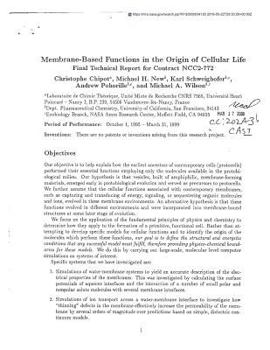
Membrane-Based Functions in the Origin of Cellular Life
No Customer Reviews

Our objective is to help explain how the earliest ancestors of contemporary cells (protocells) performed their essential functions employing only the molecules available in the protobiological milieu. Our hypothesis is that vesicles, built of amphiphilic, membrane-forming materials, emerged early in protobiological evolution and served as precursors to protocells. We further assume that the cellular functions associated with contemporary membranes, such as capturing and, transducing of energy, signaling, or sequestering organic molecules and ions, evolved in these membrane environments. An alternative hypothesis is that these functions evolved in different environments and were incorporated into membrane-bound structures at some later stage of evolution. We focus on the application of the fundamental principles of physics and chemistry to determine how they apply to the formation of a primitive, functional cell. Rather than attempting to develop specific models for cellular functions and to identify the origin of the molecules which perform these functions, our goal is to define the structural and energetic conditions that any successful model must fulfill, therefore providing physico-chemical boundaries for these models. We do this by carrying out large-scale, molecular level computer simulations on systems of interest.Chipot, Christophe and New, Michael H. and Schweighofer, Karl and Pohorille, Andrew and Wilson, Michael A.Ames Research CenterBIOLOGICAL EVOLUTION; MEMBRANE STRUCTURES; PROTOBIOLOGY; COMPUTERIZED SIMULATION; CYTOLOGY; PERMEABILITY; PEPTIDES; AQUEOUS SOLUTIONS; MATHEMATICAL MODELS
Format:Paperback
Language:English
ISBN:1723738220
ISBN13:9781723738227
Release Date:January 1
Publisher:Independently Published
Length:28 Pages
Weight:0.20 lbs.
Dimensions:0.1" x 8.5" x 11.0"
Customer Reviews
0 rating
Copyright © 2025 Thriftbooks.com
Terms of Use | Privacy Policy | Do Not Sell/Share My Personal Information | Cookie Policy | Cookie Preferences | Accessibility Statement
ThriftBooks ® and the ThriftBooks ® logo are registered trademarks of Thrift Books Global, LLC
ThriftBooks ® and the ThriftBooks ® logo are registered trademarks of Thrift Books Global, LLC
