


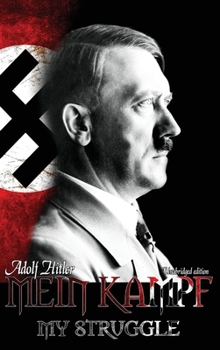
Mein Kampf - My Struggle

In 1922, just four years after the war to end all wars, an unknown Austrian then living in Bavaria planned a pamphlet to be called Settling Accounts. In it he intended to attack the ineffectiveness of the dominant political parties in Germany which were opposed to the new National Socialists (Nazis). In November 1923, Adolf Hitler was jailed for the abortive Munich Beer Hall putsch along with men willing and able to assist him with his writing. With the help of these collaborators, chief among them Rudolf Hess, the pamphlet became a book. When Mein Kampf was published in 1925, it was a failure. In 1926 a second volume appeared - it was no more successful than the first. . As Hitler's power increased, pressure was put on all party members to buy the book. Gradually this pressure was extended to all elements of the German population. Soon Mein Kampf was even being passed out to newlywed couples as a gift. Ironically, and frighteningly, by the time Hitler came to power on January 30, 1933, what has been considered by many to be the most satanic book ever written was running neck and neck with the Bible at the top of the German bestseller lists. In his excellent introduction to this definitive American translation of Mein Kampf, Mein Kampf is a blueprint for the age of chaos. It transcends in historical importance any other book of the present generation. In his translation Ralph Manheim has taken particular care to give an exact English equivalent of Hitler's highly individual, and often awkward style. We believe this book should stand as the complete, final, and definitive English version of Hitler's own story of his life, his political philosophy, and his thwarted plans for world domination. Translated by Ralph Manheim . A compilation of Hitler's most famous prison writings of 1923--the bible of National Socialism and the blueprint for the Third Reich.
Format:Hardcover
Language:English
ISBN:168204288X
ISBN13:9781682042885
Release Date:January 1
Publisher:Free Thought Books
Length:412 Pages
Weight:1.58 lbs.
Dimensions:0.9" x 6.0" x 9.0"
Customer Reviews
1 rating
People read too much into this.
Published by bernie4444 , 7 months ago
According to the Preface, this book was not written for the purpose of making friends or influencing people. The design from conception is to chronicle a movement, not create one.
You may also pay attention to the translator. And check different translations. Do not take introductions and comments as part of the book.
As a whole, one can have an opinion as to the results of the book. However, without reading it, the opinion has no chance to be informed. Another flaw with not reading this work is that you are relying on others' opinions and inferences. Taking most of the statements and conclusions from this book and displaying them separately, out of context, you would be surprised at how many you would agree with.
Just a sample of what is on the inside:
"I know people who 'read' enormously, Book for book, letter for letter, yet whom I would not describe as 'well-read.' True, they possess a mass of 'knowledge,' but their brain is unable to organize and register the material they have taken in... For reading is no end in itself, but a means to an end."
These are not platitudes but examples of observations of the time, which you can see, are timeless.
Once in a while, the reading may seem redundant, but it is the nature of writing for the time and place. So again, this book is a must-read.
Copyright © 2026 Thriftbooks.com
Terms of Use | Privacy Policy | Do Not Sell/Share My Personal Information | Cookie Policy | Cookie Preferences | Accessibility Statement
ThriftBooks ® and the ThriftBooks ® logo are registered trademarks of Thrift Books Global, LLC
ThriftBooks ® and the ThriftBooks ® logo are registered trademarks of Thrift Books Global, LLC
