


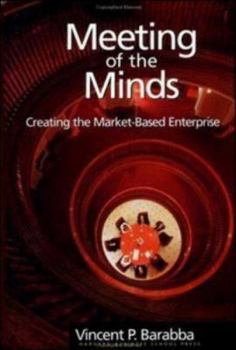
Meeting of the Minds: Creating the Market-Based Enterprise


Provides a practical blueprint for creating dynamic, market-based decision-making mechanisms that lead to competitive advantage. This book demonstrates that when companies use systems thinking to view customers and the market as an extension of the firm, they achieve a meeting of the minds - creating value for customer, community, and enterprise.
Format:Hardcover
Language:English
ISBN:0875845770
ISBN13:9780875845777
Release Date:November 1995
Publisher:Harvard Business Review Press
Length:247 Pages
Weight:1.25 lbs.
Dimensions:9.5" x 1.0" x 6.3"
Customer Reviews
2 ratings
Want to be market-oriented?
Published by Thriftbooks.com User , 23 years ago
This book started with some basic management concepts and marketing concepts such as organizational structures to give you basic ideas on an organization. Then, in the latter chapters, the author introduced the concept of ideal market-based enterprise and brought in the ways to become a market-based enterprise. The Listen-Learn-Lead approach suggested by the author is practical and easy to understand. I love that approach personally since it would be useful for my future career.As the author possess over 30 years executive experience, you can definitely share his experience in this book. As in this cyber year, the market trend always keep changing, thus being market-oriented is essential to maintain competitive. This book is worth to read if you want your organization to be market-oriented.
Best book on marketing as organisation-wide learning
Published by Thriftbooks.com User , 28 years ago
From Chris Macrae wcbn007@easynet.co.uk Join 100 marketing opinion leaders from 15 countries currently discussing this book's vital lessons for organisations with a marketing future. This is where we have got to as of March97... Which are your favourite books or other texts which mesh marketing and learning organisation principles together in such a way that a marketing practitioner will add "learning organisation" constructs to his/her tool kit without worrying whether other people would classify them as marketing work? Two votes for Vince Barabba's book "Meeting of the Minds" come from Tim Ambler ("excellent book and his approach has inspired some quite sophisticated market research in GM") and myself. Below, an abstracted historical summary of how and why marketing stopped working in many Western companies of the 70s/80s. Finally, my concluding questions are tabled......Words are directly abstracted from Barabba except some linking paragraphs of mine in parentheses: Page 43 THE RISE AND FALL OF THE MARKETING CONCEPT The late 50s and the 1960s, a period of economic expansion, were the golden age of marketing. It was a period in which (US) companies like General Electric, Pilsbury, and Procter & Gamble were guided by executives who actively integrated marketing into every phase of the business. Peter Drucker writing at about the same time, likewise identified the central role of marketing and innovation. To him, marketing encompassed the whole business and meant more than selling products and services or creating a marketing department. "Marketing" he wrote "is so basic that ...it is not a specialised activity at all. It is the whole business seen from the point of view of its final result, that is from the customer's point of view." The marketing concept held the highground in management thinking for almost two decades, and these were great years for American business. Personal incomes and markets expanded dramatically between the 1950s and 1970." (Then marketing as organisation-wide learning and customer-oriented innovation process stopped in thw West... until the Japanese woke all would-be world class businesses up. The Japanese lapped up marketing as an inter-disciplinary concept with tools as TQM, Quality Function Deployment, Hoshin Planning, as recent revelations of knowledge-creation being an essentially Japanese corporate advantage (Nonaka et al, The Knowledge Creating Company), and target market costing as an organisation-wide process which the Japanese use (instead of accountants' measures) so that an informing consensus integrates all decisions for new product business development (Robin Cooper, When Lean Enterprises Collide)) (page 47) One example of a Japanese management technique now widely adopted in North America is Total Quality Management (TQM), a customer-focused philosophy and strategy that seeks continuous improvement in business processes through the application of analytical tools and te
Copyright © 2025 Thriftbooks.com
Terms of Use | Privacy Policy | Do Not Sell/Share My Personal Information | Cookie Policy | Cookie Preferences | Accessibility Statement
ThriftBooks ® and the ThriftBooks ® logo are registered trademarks of Thrift Books Global, LLC
ThriftBooks ® and the ThriftBooks ® logo are registered trademarks of Thrift Books Global, LLC
