


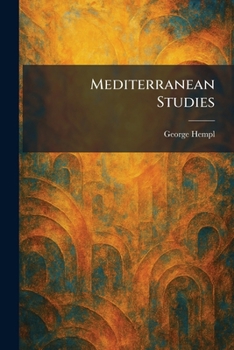
Mediterranean Studies

"Mediterranean Studies" is a profound exploration into the linguistic and cultural foundations of the ancient Mediterranean world. Authored by the noted philologist and linguist George Hempl, this work delves into the complex history of early civilizations, with a particular focus on the evolution of languages and scripts that shaped the region. Hempl's scholarly approach combines archaeological findings with comparative linguistics to shed light on the origins of various Mediterranean peoples and their interconnected histories.
The volume offers detailed analyses of undeciphered scripts and ancient inscriptions, seeking to decode the mysteries of Minoan, Etruscan, and other early scripts. By examining the phonetic and structural elements of these languages, Hempl provides a compelling narrative of cultural transmission and development across the Mediterranean basin. This work remains a significant contribution to the fields of classical studies, historical linguistics, and archaeology.
Whether examining the nuances of archaic dialects or the broader movement of civilizations, "Mediterranean Studies" serves as an essential resource for scholars and students interested in the roots of Western civilization. Its rigorous methodology and insightful interpretations offer a timeless look into the ancient world's linguistic heritage.
This work has been selected by scholars as being culturally important, and is part of the knowledge base of civilization as we know it. This work was reproduced from the original artifact, and remains as true to the original work as possible. Therefore, you may see the original copyright references, library stamps (as most of these works have been housed in our most important libraries around the world), and other notations in the work.
This work is in the public domain in the United States of America, and possibly other nations. Within the United States, you may freely copy and distribute this work, as no entity (individual or corporate) has a copyright on the body of the work.
As a reproduction of a historical artifact, this work may contain missing or blurred pages, poor pictures, errant marks, etc. Scholars believe, and we concur, that this work is important enough to be preserved, reproduced, and made generally available to the public. We appreciate your support of the preservation process, and thank you for being an important part of keeping this knowledge alive and relevant.
Customer Reviews
ThriftBooks ® and the ThriftBooks ® logo are registered trademarks of Thrift Books Global, LLC
