


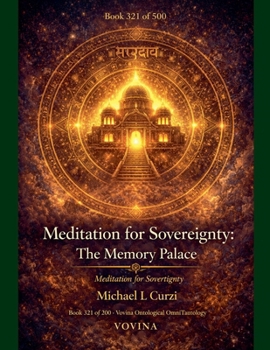
Meditation for Sovereignty: The Memory Palace

Meditation for Sovereignty: The Memory Palace is Book 321 in Michael L. Curzi's 500-volume philosophical canon, the Vovina Ontological OmniTautology. Part of the Meditation for Sovereignty sequence within the Spirituality and Practice branch of the project, the book explores memory as a foundational architecture of consciousness, identity, and knowledge transmission.
The work centers on the Sanskrit root SAMPRADAYA, meaning lineage transmission or the passage of wisdom across generations. In this framework, memory is not treated merely as a cognitive storage system but as a living network through which knowledge, culture, and consciousness propagate through individuals and societies.
Structured in nineteen chapters following the architectural design used throughout the VOVINA canon, the book presents a layered inquiry method that moves through observation, discrimination, application, connection, and integration. This progression mirrors both contemplative practice and scientific investigation, guiding readers from conceptual understanding toward direct experiential insight.
At the center of the text lies the concept of the Memory Palace-an expanded interpretation of the classical mnemonic system. In Curzi's formulation, the memory palace becomes a multidimensional framework for organizing perception, experience, and knowledge across physical, cognitive, and cultural domains. Memory is understood as the structural continuity that allows consciousness to persist through time while adapting to new information.
The book draws from contemplative traditions such as Advaita Vedanta alongside modern research in neuroscience, cognitive science, and systems theory. Studies of meditation and brain function-including suppression of the default mode network and synchronized neural activity during deep attentional states-are examined alongside philosophical discussions of the witnessing awareness underlying experience.
The work also explores how systems of knowledge survive and evolve through structured transmission. Techniques for preserving ideas, evidence, and intellectual lineage are examined through the lens of epistemology, archival science, and emerging digital frameworks for information integrity.
Within the broader VOVINA project, Meditation for Sovereignty: The Memory Palace contributes to the ongoing investigation known as Variable X, the unresolved principle linking the entire five-hundred-volume canon.
Blending philosophy, contemplative practice, and systems thinking, the book invites readers to consider how memory-both personal and collective-functions as the architecture through which knowledge persists, evolves, and ultimately shapes the trajectory of human understanding.
Customer Reviews
ThriftBooks® and the ThriftBooks® logo are registered trademarks of Thrift Books Global, LLC
