


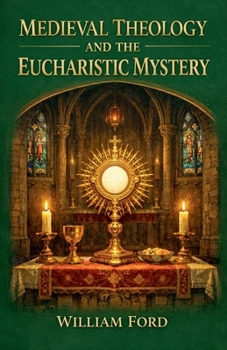
Medieval Theology and the Eucharistic Mystery

From the earliest centuries of the Church, the Eucharist has stood at the center of Christian life, doctrine, and worship. Yet it was in the medieval period-stretching roughly from the Carolingian reforms to the threshold of the Council of Trent-that the mystery of the Eucharist received its most extensive, systematic, and imaginative theological elaboration. Medieval theologians, monks, mystics, canonists, artists, and ordinary faithful alike approached the Eucharist not merely as one sacrament among many, but as the sacrament in which the entire Christian mystery converges. It was the locus of divine presence, the memorial of Christ's sacrifice, the pledge of future glory, and the beating heart of the Church's liturgical life. To study medieval theology is therefore, in a profound sense, to study the Eucharist; and to study the Eucharist is to enter into the deepest currents of medieval Catholic thought.
This book seeks to explore the Eucharistic mystery as it was understood, celebrated, defended, and contemplated throughout the medieval centuries, drawing upon the rich tapestry of sources that shaped the Catholic tradition. The medieval period was not monolithic. It encompassed the patristic inheritance, the rise of monastic culture, the emergence of scholastic method, the flourishing of mystical theology, the development of canon law, and the challenges posed by heresy and philosophical innovation. Yet through all these diverse currents, the Eucharist remained the unifying center. Whether one reads the homilies of Bede, the hymns of Aquinas, the visions of Hildegard, the decrees of Lateran IV, or the architectural symbolism of Gothic cathedrals, one encounters a consistent conviction: that in the Eucharist, Christ Himself is truly present, offering His Body and Blood for the salvation of the world.
Customer Reviews
ThriftBooks ® and the ThriftBooks ® logo are registered trademarks of Thrift Books Global, LLC
