


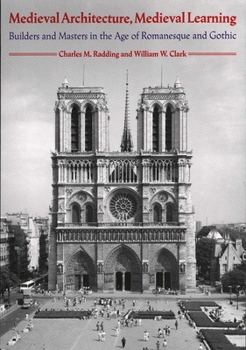
Medieval Architecture, Medieval Learning: Builders and Masters in the Age of Romanesque and Gothic


Select Format
Select Condition 
Book Overview
In this book Charles M. Radding and William W. Clark offer fresh perspectives on changes in architecture and learning during the Romanesque and Gothic periods, arguing that builders and masters shared similar ways of reasoning and solving problems. "Erwin Panofsky's intuition about the relationship between scholastic knowledge and architecture finds its justification and correction in this very suggestive and convincing essay. A brilliant demonstration of the creativity of medieval intellectuals, from Ab lard to the masters of Saint Denis and Reims, and of the modernity of the twelfth century, the greatest century of the Middle Ages."-Jacques Le Goff "This book was waiting to be written. . . . Radding and Clark present sound expositions of the history of learning and architecture in the period, and readers working in either area will come away with an enhanced understanding of the culture of the eleventh and twelfth centuries in western Europe."-Eric Fernie, Society of Architectural Historians of Great Britain Newsletter
Format:Paperback
Language:English
ISBN:0300061307
ISBN13:9780300061307
Release Date:September 1994
Publisher:Yale University Press
Length:180 Pages
Weight:1.01 lbs.
Dimensions:0.5" x 7.0" x 10.0"
Customer Reviews
1 rating
A Difficult but Beneficial Read for the Medievalist
Published by Thriftbooks.com User , 17 years ago
This is an unusual book. I picked it up because I am interested in both medieval educational practices and the history of medieval architecture, and so the title "seemed to say it all" to me. Nevertheless, getting oriented to the text and then actually moving through it proved to be a difficult task. This book is oriented at a more scholarly audience, and the writing is similar to what we might find in an academic journal. This is both its strength and weakness: the text provides remarkable, scholarly detail on both subjects, but the book might at first blush (look at its cover) appear to be marketed to a general audience. Having said that, there is a great deal of content the general reader who is interested in these two subjects will find of interest, but he or she will have to work to pull it out of the work. This book is not meant for a quick read, nor is its language delivered in a manner that anticipates the generalist. You will have to work at it, but you'll get much out of the effort if you do. The major idea this book promotes is that the eleventh century was a unique and pivotal moment for both architecture and systematized educational structures in medieval Europe. Not going so far as the "Panofsky Theory" of the alleged association between Gothic architecture and Scholasticism, but nevertheless arguing that these two fields underwent similar shifts at the same moment in history, the text presents the thesis that it was the shift of these two areas from individual undertakings into regular disciplines that accounts for the greatest levels of similarities between them. To make the point, the authors present numerous historical examples from both areas in chronological order and attempt to demonstrate how each coalesced into disciplines that propelled the areas beyond the Middle Ages. In architecture, for example, we see how the medieval builders learned from the lessons of St. Denis, Laon, Notre Dame de Paris, and Sens to establish Gothic as a broadly understood style that could eventually be exported across France, and eventually, with the advent of the Rayonnant style, all of Europe. In education, we see, for example, how the battles over specific issues in the tenth century eventually exhausted themselves, and a more systematic approach based on logic (and grammar) was to replace such idiosyncratic debates. It is the crystallization of these two areas into systematic disciplines in the eleventh century, as typified by these and many other examples, that is the focus of this book. Not for the armchair reader, but certainly a great read for any medievalist, the book is a treasure trove of detail for the examples it selects, and the bibliography alone is a great resource for further study. Whether or not you can be convinced of the thesis, this is a good work with plenty to leave you hungry for more. If you are a medieval architecture enthusiast, or if you are interested in the history of education, you should definitely add this wor
Copyright © 2026 Thriftbooks.com
Terms of Use | Privacy Policy | Do Not Sell/Share My Personal Information | Cookie Policy | Cookie Preferences | Accessibility Statement
ThriftBooks ® and the ThriftBooks ® logo are registered trademarks of Thrift Books Global, LLC
ThriftBooks ® and the ThriftBooks ® logo are registered trademarks of Thrift Books Global, LLC
