


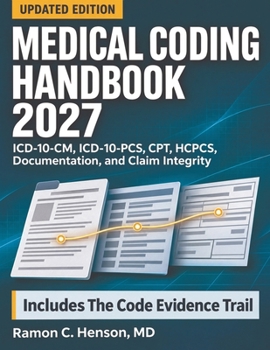
Medical Coding Handbook 2027: ICD-10-CM, ICD-10-PCS, CPT, HCPCS, Documentation, and Claim Integrity

Turn Clinical Documentation Into Defensible Coding Decisions
Medical Coding Handbook 2027 connects the clinical record to the classification, sequencing, and claim decisions that follow. Written for working coders, auditors, health information professionals, and advanced students, it covers FY 2027 ICD-10-CM, the current ICD-10-PCS release, CPT 2027 architecture, HCPCS Level II, evaluation and management, modifier logic, and claim reconciliation without reproducing licensed codebook content.
The Code Evidence Trail keeps four elements visible in every domain: the documented fact, the governing rule, the reporting result, and the audit record needed to defend it.
Build the Skills to Code and Audit Across Settings
Control effective dates across annual and quarterly releases - select the code set that belongs to the service date.
Navigate ICD-10-CM conventions and setting boundaries - distinguish principal, first-listed, additional, uncertain, and symptom reporting.
Construct ICD-10-PCS procedures from operative objectives - resolve root operation, body part, approach, device, and qualifier.
Apply CPT and E/M architecture without descriptor shortcuts - connect service family, decision making, time, components, and edits to documentation.
Reconcile HCPCS products, units, modifiers, and equipment status - preserve the evidence behind supplies, drugs, and durable equipment.
Assemble claims that survive review - align diagnoses, services, dates, units, provider roles, edits, corrections, and appeals.
Run coding quality and 2027 change control - design audit samples, classify errors, improve queries, and govern release deployment.
Use this handbook to make every coding choice traceable from the signed record to the submitted claim.
Customer Reviews
ThriftBooks ® and the ThriftBooks ® logo are registered trademarks of Thrift Books Global, LLC
