


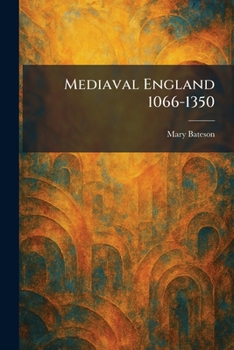
Mediaval England 1066-1350

"Mediaval England 1066-1350" is an insightful and scholarly examination of the social and political transformation of England during the High Middle Ages. Written by the respected historian Mary Bateson, this work provides a comprehensive overview of the period starting from the Norman Conquest in 1066 and concluding in the mid-14th century. Bateson shifts the analytical focus from purely political or military narratives to delve deeply into the social life, legal structures, and domestic habits of the people.
The book explores the evolution of feudalism, the growth of the English court, and the changing roles of the clergy and the peasantry. By meticulously analyzing the domestic environment alongside the grander shifts in statecraft, Bateson offers a vivid picture of how medieval society functioned on both a macro and micro level. Readers will find detailed accounts of the lifestyle within manor houses, the development of towns, and the intricate hierarchy that defined the age. As a classic work of historical scholarship, "Mediaval England 1066-1350" remains an essential resource for students and enthusiasts of British history, providing a window into the formative centuries that shaped the modern English identity.
This work has been selected by scholars as being culturally important, and is part of the knowledge base of civilization as we know it. This work was reproduced from the original artifact, and remains as true to the original work as possible. Therefore, you may see the original copyright references, library stamps (as most of these works have been housed in our most important libraries around the world), and other notations in the work.
This work is in the public domain in the United States of America, and possibly other nations. Within the United States, you may freely copy and distribute this work, as no entity (individual or corporate) has a copyright on the body of the work.
As a reproduction of a historical artifact, this work may contain missing or blurred pages, poor pictures, errant marks, etc. Scholars believe, and we concur, that this work is important enough to be preserved, reproduced, and made generally available to the public. We appreciate your support of the preservation process, and thank you for being an important part of keeping this knowledge alive and relevant.
Related Subjects
HistoryCustomer Reviews
ThriftBooks ® and the ThriftBooks ® logo are registered trademarks of Thrift Books Global, LLC
