


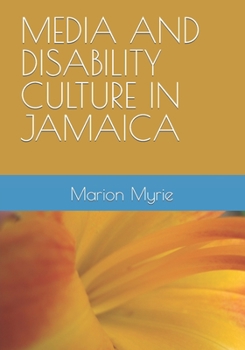
Media and Disability Culture in Jamaica
No Customer Reviews

When persons with disabilities appear in the media, the reason is quite often to showcase disability. Many Jamaican producers would acknowledge that they have never considered including disabled persons in any part of their productions. While broadcasters are very conscious in ensuring a mix of gender and race on-screen and on-air, there is less effort made toward ensuring that these programmes adequately reflect the society as a whole.
This phenomenon is particularly worrying when the role of the media is chiefly to educate, inform and provide entertainment to the masses (Maxwell, 2000). McQuail states that it has continuing significance in contemporary society in the economic, cultural, social, and political spheres (McQuail, 2010). He goes on to further say that everyday social life, lifestyles and conversations are influenced by the contents of mass media because of the fact that the individual spends much time interacting with media (McQuail, 2010). Persons with disabilities (PWD) which constitute some 15% of the general population (The World Health Organization, 2011) are underrepresented in mainstream media (news, television shows, movies and current events) in Jamaica. When PWD do appear in the media their portrayal is stigmatized and stereotypical.
Disability is an "evolving concept", according to the Convention on the Rights of Persons with Disabilities (CRPD), and it emphasizes that "disability results from the interaction between persons with impairments and attitudinal and environmental barriers that hinder their full and effective participation in society on an equal basis with others" (United Nations, 2014). Looking at disability as an interaction means that "disability" is not an attribute of the person and that improved social participation of the disabled can be made possible by addressing the barriers which hinder them in their everyday life (The World Health Organization, 2011). This is important as we must acknowledge that media depiction of disability influences the way PWD are treated in society and thus the way they live their lives. If Jamaica as a whole is to reach the Vision 2030 goal of creating a country that is the place of choice, to live, work, raise families and do business, we need to address the way we treat persons who are otherwise able. If Jamaica succeeds it will be a model of a truly inclusive country that respects the humanity of all.
Key Words: Disability; Mass Media; Inclusion; Disability Culture.
This phenomenon is particularly worrying when the role of the media is chiefly to educate, inform and provide entertainment to the masses (Maxwell, 2000). McQuail states that it has continuing significance in contemporary society in the economic, cultural, social, and political spheres (McQuail, 2010). He goes on to further say that everyday social life, lifestyles and conversations are influenced by the contents of mass media because of the fact that the individual spends much time interacting with media (McQuail, 2010). Persons with disabilities (PWD) which constitute some 15% of the general population (The World Health Organization, 2011) are underrepresented in mainstream media (news, television shows, movies and current events) in Jamaica. When PWD do appear in the media their portrayal is stigmatized and stereotypical.
Disability is an "evolving concept", according to the Convention on the Rights of Persons with Disabilities (CRPD), and it emphasizes that "disability results from the interaction between persons with impairments and attitudinal and environmental barriers that hinder their full and effective participation in society on an equal basis with others" (United Nations, 2014). Looking at disability as an interaction means that "disability" is not an attribute of the person and that improved social participation of the disabled can be made possible by addressing the barriers which hinder them in their everyday life (The World Health Organization, 2011). This is important as we must acknowledge that media depiction of disability influences the way PWD are treated in society and thus the way they live their lives. If Jamaica as a whole is to reach the Vision 2030 goal of creating a country that is the place of choice, to live, work, raise families and do business, we need to address the way we treat persons who are otherwise able. If Jamaica succeeds it will be a model of a truly inclusive country that respects the humanity of all.
Key Words: Disability; Mass Media; Inclusion; Disability Culture.
Format:Paperback
Language:English
ISBN:B09F16L6HW
ISBN13:9798468375013
Release Date:August 2021
Publisher:Independently Published
Length:76 Pages
Weight:0.33 lbs.
Dimensions:0.2" x 7.0" x 10.0"
Customer Reviews
0 rating
Copyright © 2026 Thriftbooks.com
Terms of Use | Privacy Policy | Do Not Sell/Share My Personal Information | Cookie Policy | Cookie Preferences | Accessibility Statement
ThriftBooks ® and the ThriftBooks ® logo are registered trademarks of Thrift Books Global, LLC
ThriftBooks ® and the ThriftBooks ® logo are registered trademarks of Thrift Books Global, LLC
