


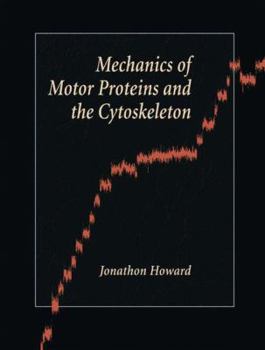
Mechanics of Motor Proteins and the Cytoskeleton
No Customer Reviews

Select Format
Select Condition 
Book Overview
This text is for biology, biochemistry and chemistry students who want to learn about the principles of protein mechanics and how it applies to the morphology and motility of cells. Understanding how motors and the cytoskeleton operate requires mechanical concepts such as force, elasticity and damping. Introductory physics textbooks address these concepts, yet they are concerned primarily with macroscopic systems, whose motions are qualitatively different from the highly damped, diffusive motion of individual molecules; this book provides a physical foundation for molecular mechanics. Part I explains how small particles like proteins respond to mechanical, thermal, and chemical forces, Part II focuses on cytoskeletal filaments, and Part III focuses on motor proteins. The treatments are unified in the respect that they are organized around principles rather than proteins: chapters are centered on topics such as structure, chemistry, and mechanics, and different filaments or motors are discussed together.
Format:Hardcover
Language:English
ISBN:0878933344
ISBN13:9780878933341
Release Date:January 2001
Publisher:Sinauer Associates Inc
Length:367 Pages
Weight:2.05 lbs.
Dimensions:9.3" x 0.8" x 7.0"
Customer Reviews
0 rating
Copyright © 2026 Thriftbooks.com Terms of Use
| Privacy Policy | Do Not
Sell/Share My Personal Information | Cookie Policy | Cookie Preferences | Accessibility Statement
ThriftBooks® and the ThriftBooks® logo are registered trademarks of Thrift Books Global, LLC
ThriftBooks® and the ThriftBooks® logo are registered trademarks of Thrift Books Global, LLC
