


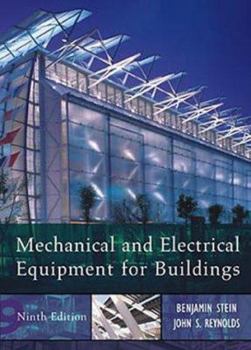
Mechanical and Electrical Equipment for Buildings


Select Format
Select Condition 
Book Overview
Revised
Format:Hardcover
Language:English
ISBN:0471156965
ISBN13:9780471156963
Release Date:December 1999
Publisher:Wiley & Sons, Incorporated, John
Length:1824 Pages
Weight:6.20 lbs.
Dimensions:2.5" x 7.7" x 10.3"
Customer Reviews
5 ratings
MEEB Bow Down
Published by Thriftbooks.com User , 21 years ago
If you want to know more than most Architects and Engineers about how to design the guts of buildings this is the book to use. It's a fat guy though! Sometimes the text seems to weigh you down. Most architectural students consider it a sloug! But, once they graduate, they use it throughout their careers as design professionals. If you want to know how to develop a regional climatic response strategy for your building or development, calculate passive ventillation rates or heat gains and losses on unique configurations of wood, siding and insulation; size gutters or a rain water catchment system or plan for an elevator, this is the book for you.
review of Mechanical and Electrical Equipment for Buildings, 9th Edition by Ben Stein
Published by Thriftbooks.com User , 21 years ago
This is the best reference for Architects and students studying mech. & elec. equipment
Best One-Volume Resource For Engineers
Published by Thriftbooks.com User , 21 years ago
If you are an engineer engaged in the design of mechanical and electrical systems for commercial and institutional buildings, you may find this your most valuable reference for an overview of theory and best practices for the entire gamut of building systems. I did find a bit too much enthusiasm for environmentally friendly and energy-conserving new ideas. Many of these technologies are worth following but have economic results that will not serve your clients well. I am a professional engineer (leading my own firm) with 40 years of experience and have a huge library including the eighth and ninth editions of this book; it's one of my favorites. It's must reading for a new engineer because you will be able to understand the basics of areas that are new to you with an hour or two of study.
An author's view:
Published by Thriftbooks.com User , 24 years ago
My part of this book (mechanical and plumbing) is designed to first show how to minimize the need for mechanical equipment by designing with the climate and site firmly in mind. First configure a building to optimize daylighting, solar heating, and various climate-appropriate passive cooling methods. Also, to store rainwater when appropriate. Then, proceed to choose and size the back-up equipment. In this way, designers conserve non-renewable energy, utilize natural (on-site) energy sources, and also help building occupants stay in touch with the outdoors. I believe that we'll tend to care more about a clean outdoor environment if we are kept aware of its condition.For a summary of this approach, read Chapter One. I hope you enjoy this book, even when it is your textbook! That was my object. Suggestions? I'm at jreyn@darkwing.uoregon.edu
Top Notch Reference
Published by Thriftbooks.com User , 26 years ago
This volume is one of the best reference materials available for the MEP or Architectural Engineer. I found the descriptive detail and illustration that aided me in the learning process. I reccomend it highly.
Copyright © 2026 Thriftbooks.com
Terms of Use | Privacy Policy | Do Not Sell/Share My Personal Information | Cookie Policy | Cookie Preferences | Accessibility Statement
ThriftBooks ® and the ThriftBooks ® logo are registered trademarks of Thrift Books Global, LLC
ThriftBooks ® and the ThriftBooks ® logo are registered trademarks of Thrift Books Global, LLC
