


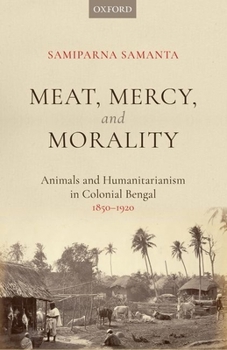
Meat, Mercy, Morality: Animals and Humanitarianism in Colonial Bengal, 1850-1920
No Customer Reviews

This book disentangles complex discourses around humanitarianism to understand the nature of British colonialism in India. It contends that the colonial project of animal protection in late nineteenth-century Bengal mirrored an irony. Emerging notions of public health and debates on cruelty against animals exposed the disjunction between the claims of a benevolent Empire and a powerful imperial reality where the state constantly sought to discipline its subjects-both human and nonhuman. Centered around stories of animals as diseased, eaten, and overworked, the
book shows how such contests over appropriate measures for controlling animals became part of wider discussions surrounding environmental ethics, diet, sanitation, and the politics of race and class. The author
combines history with archive, arguing that colonial humanitarianism was not only an idiom of rule, but was also translated into Bengali dietetics, anxieties, vegetarianism, and vigilantism, the effect of which can be seen in
contemporary politics of animal slaughter in India.
book shows how such contests over appropriate measures for controlling animals became part of wider discussions surrounding environmental ethics, diet, sanitation, and the politics of race and class. The author
combines history with archive, arguing that colonial humanitarianism was not only an idiom of rule, but was also translated into Bengali dietetics, anxieties, vegetarianism, and vigilantism, the effect of which can be seen in
contemporary politics of animal slaughter in India.
Format:Hardcover
Language:English
ISBN:0190129131
ISBN13:9780190129132
Release Date:November 2021
Publisher:Oxford University Press
Length:288 Pages
Weight:0.89 lbs.
Dimensions:0.9" x 5.9" x 8.8"
Customer Reviews
0 rating
Copyright © 2026 Thriftbooks.com
Terms of Use | Privacy Policy | Do Not Sell/Share My Personal Information | Cookie Policy | Cookie Preferences | Accessibility Statement
ThriftBooks ® and the ThriftBooks ® logo are registered trademarks of Thrift Books Global, LLC
ThriftBooks ® and the ThriftBooks ® logo are registered trademarks of Thrift Books Global, LLC
