


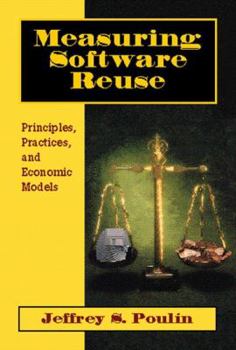
Measuring Software Reuse: Principles, Practices, and Economic Models

This book documents methods for quantifying the benefits of software reuse so that developers can accurately judge whether the benefits outweigh the disadvantages. It explains how to apply reuse... This description may be from another edition of this product.
Format:Paperback
Language:English
ISBN:0201634139
ISBN13:9780201634136
Release Date:January 1996
Publisher:Addison-Wesley Professional
Length:195 Pages
Weight:1.06 lbs.
Dimensions:9.8" x 0.8" x 6.8"
Customer Reviews
4 ratings
Metrics and models - No nonsense or hype
Published by Thriftbooks.com User , 24 years ago
In my opinion this is the most detailed and systematic treatments of reuse from business and development process strategy points of view. Among the things I especially like about this book are: (1) the book addresses only blackbox reuse (assets that are used without modification) and defines the assets as both code and documentation instead of code alone. This is consistent with contemporary component-based software engineering practices, making this 1997 book's content valid in 2001. (2) The overview of reuse metrics is illuminating in that this chapter exposes flaws in the reuse percent model, and offers alternatives such as a leverage model and economic models (cost avoidance, ROI and cost/benefit). (3) Relative costs of developing with reuse of *for* reuse - each approach has some significant strengths, but each approach has quantifiable costs, which are thoroughly analyzed. (4) Counting rules. Here the rules for what to count as "reuse" are discussed. This is one area that, without defined rules, can result in inflated claims or skewed results. I especially like that fact that while the author prefers lines of code as a basis, he also shows how to use function points, objects, etc. to get accurate baseline metrics.One of the most useful chapters, 5, covers measuring reuse and reuse benefits. It's useful because in this "one size does not fit all" profession the nine different metrics and economics models provided give you an array of choices from which to choose. Chapter 6's Applying Reuse Metrics on a Project reinforces the preceding chapters. Possibly the strongest chapter (to me at least) is 9, which covers reuse across the life cycle. The material here dovetails nicely with a later book by Carma McClure titled "Software Reuse: A Standards-Based Guide".Overall, this book stands as the definitive work on software reuse metrics and is probably more applicable today because of the strong movement towards component-based software engineering and off-shore development than when it was first written.
A Wealth of Practical Knowledge!
Published by Thriftbooks.com User , 25 years ago
This book clearly explained the toughest problems associated with measuring reuse. It had numerous practical examples and references to break down the most difficult topics- especially "what should I measure?" in Chapter 4. I found the approach practical and applicable to any organization.
Great advice for all languages!
Published by Thriftbooks.com User , 25 years ago
This book clearly explains reuse issues better than I have found anywhere else. It has practical advice on how to measure in all languages, to include object-oriented development and the reuse of things beyond just code (like documentation). I highly recommend this book to anyone working in reuse, component-based development, or related efforts.
Excellent Practical Guide to Measuring Reuse!
Published by Thriftbooks.com User , 25 years ago
This book explained things that no one else ever had presented, especially all the difficulties in actually getting a project to implement reuse metrics. I found it invaluable. It covers all languages (we use C++) and on my project we used the example metrics in the book to establish our own reuse program! I highly recommend the book!
Copyright © 2026 Thriftbooks.com Terms of Use
| Privacy Policy | Do Not
Sell/Share My Personal Information | Cookie Policy | Cookie Preferences | Accessibility Statement
ThriftBooks® and the ThriftBooks® logo are registered trademarks of Thrift Books Global, LLC
ThriftBooks® and the ThriftBooks® logo are registered trademarks of Thrift Books Global, LLC
