
Skip to content
Scan a barcode
Scan
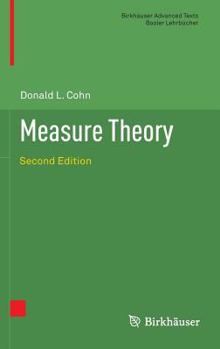
Hardcover Measure Theory: Second Edition Book

ISBN: 1461469554

ISBN13: 9781461469551

Measure Theory: Second Edition

Select Format

Select Condition ThriftBooks Help Icon

Recommended

Format: Hardcover

Condition: New

$99.00
Ships within 2-3 days
Save to List

Book Overview

Intended as a self-contained introduction to measure theory, this textbook also includes a comprehensive treatment of integration on locally compact Hausdorff spaces, the analytic and Borel subsets of Polish spaces, and Haar measures on locally compact groups. This second edition includes a chapter on measure-theoretic probability theory, plus brief treatments of the Banach-Tarski paradox, the Henstock-Kurzweil integral, the Daniell integral, and the existence of liftings.

Measure Theory provides a solid background for study in both functional analysis and probability theory and is an excellent resource for advanced undergraduate and graduate students in mathematics. The prerequisites for this book are basic courses in point-set topology and in analysis, and the appendices present a thorough review of essential background material.

Related Subjects

Math Mathematics Science & Math

Customer Reviews

5 ratings

A good introduction to Measure Theory

I used this book for my graduate measure theory class. We covered the first seven chapters. The book is written in a clear fashion and is easy to follow. It is concise and at the same time is almost self contained. The first chapter gives an introduction to measure theory. It deals with sigma algebras, measures, outer measures, completeness and regularity. The lebesgue measure is also introduced in this chapter. The second chapter starts of measurable functions. It then proceeds to almost sure properties followed by integration. These are followed by the theorem: Monotone convergence theorem, Beppo Levi theorem, Fatou's Lemma and Dominated Convergence Theorem. The chapter also discusses briefly on Riemann integrals. The third chapter is on different modes of convergence. It proves the Egoroff theorem. This is followed by the definition and properties of Banach spaces. The fourth chapter discusses signed measures. The Hahn decomposition theorem and Jordan decomposition theorems are proved. It is followed by absolutely continuous measures which leads to Radon-Nikodym theorem. The fifth chapter deals with Product measures. The most important theorem in this chapter is the Fubini's theorem which is proved in the second section. The sixth chapter is on differentiation of measures. Proves Fundamental theorem of calculus. The seventh chapter is on Hausdorff spaces and Riesz representation theorem followed by properties of regular measures (Lusin's theorem) Chapter 8 is on Polish Spaces and Analytic Sets Chapter 9 is on Haar Measures (We did not cover the last two chapters in this course)

A great companion to Folland or Rudin

I believe that Cohn's Measure Theory is a fantastic companion for learning Analysis in concert with one of the denser books from Folland or Rudin. While still covering a wide range of subjects, Cohn's exposition is much more conducive to the learning experience than either of the other two, in my opinion. He does an excellent job of explaining his reasoning in proofs, while still leaving enough to the reader to get them involved in the process. The exercises are also very well done, and range over a wide difficulty level, though are easier, on the whole, than those in the other two books. This book, even by itself, will give you a VERY strong foundation in measure theory and integration theory, and has the benefit of being very affordable.

A Book of Clarity and Rigor

Cohn's Measure Theory is one of the most clear, rigorous and easy-going textbooks I have ever read. All theorems, propositions, lemmas are stated in full; there is neither a missing hypothesis, nor an obscure conclusion. Moreover, the number of errors in the book is minimal when compared to other texts in mathematics.

Good text book

This is a good text book on measure theory, including appendices of concepts from other fields of mathematics that are used in this text and exercises at the end of each section. It is quite dense reading, and the proofs often omit "trivial" steps that may not be so obvious to the student - these omissions often can constitute exercises of their own for the undergraduate.

Solid, challenging, complete

I picked Cohn's book to teach myself measure theory, after reviewing several good candidates. Cohn's book struck for me the right balance between expository clarity, mathematical rigor, and intuition. Though it makes no mention of probability theory, which was my underlying motivation for learning measure theory in the first place, I found it clearer than other more probability-oriented treatments of measure theory. The appendices do an excellent job of summarizing the required mathematical background. For those readers willing to take the results listed in the appendices on faith, the book should be reasonably self-contained. Otherwise, prior exposure to real analysis and point-set topology (at the level of, say, Simmons' "Introduction to Topology and Modern Analysis") would help reading this book. The exercises are challenging, but illuminating and worth the effort (no routine exercises in this book!). Particularly recommended is chapter 8 on Polish spaces.
Copyright © 2026 Thriftbooks.com Terms of Use | Privacy Policy | Do Not Sell/Share My Personal Information | Cookie Policy | Cookie Preferences | Accessibility Statement
ThriftBooks ® and the ThriftBooks ® logo are registered trademarks of Thrift Books Global, LLC

GoDaddy Verified and Secured