


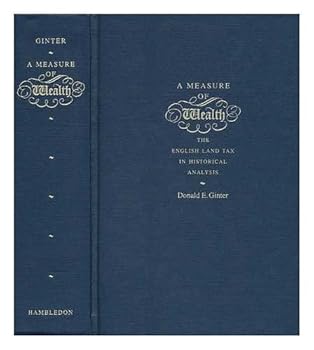
A Measure of Wealth: The English Land Tax in Historical Analysis

The land tax duplicates -- which ostensibly provide a complete yearly inventory of all landowners and tenants in every county in the United Kingdom, parish by parish -- are considered the most important systematic documentation available on British landed society between the Domesday Book of 1086 and the New Domesday of 1873. Throughout the past century the duplicates have been central to many questions at the heart of the most heated academic and political concerns, but their reliability as historical documentation has not previously been questioned systematically. In A Measure of Wealth, Donald Ginter launches a sweeping attack -- with devastating conclusions -- on the previous uses of the land tax duplicates as the evidential base of many of the leading questions in modern British historiography: the decline of the small landowner, the impact of enclosure, and the study of wealth inequalities.
Ginter focuses on the years 1780 to 1832, a period for which many land tax records survive and precisely when modern forms of political organization began to emerge and when industrialization and enclosure are thought to have altered the fabric of society and the economy. Through an examination of more than 5,000 parishes in fifteen historical counties -- approximately one-third of England -- he shows that inequalities in the burden of national taxation were far greater than anyone has estimated. Having researched both local and national taxation procedures, he reveals that, on the eve of the nineteenth-century "Revolution in Government," the tenantry and yeomanry were administratively far more independent of parliamentary statute and of their local gentry and magistracy than has previously been suggested. Drawing on evidence from the three ridings of Yorkshire, he discloses other problems associated with the land tax duplicates. While Ginter argues that the land tax duplicates are wholly inadequate for the study of the fortunes of the small yeoman and that the literature on this subject must be fundamentally reconsidered, he reveals a method which can reliably exploit the land tax duplicates as a systemic documentation. He contends that the full potential for studies based centrally on the land tax has scarcely begun to be explored.Customer Reviews
ThriftBooks ® and the ThriftBooks ® logo are registered trademarks of Thrift Books Global, LLC
