


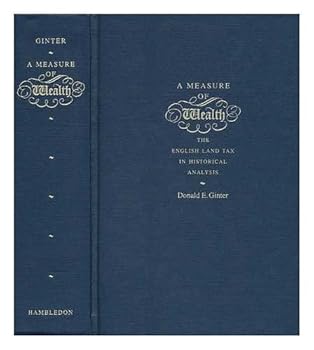
A Measure of Wealth: The English Land Tax in Historical Analysis
No Customer Reviews

Ginter focuses on the years 1780 to 1832, a period for which many land tax records survive and precisely when modern forms of political organization began to emerge and when industrialization and enclosure are thought to have altered the fabric of society and the economy. Through an examination of more than 5,000 parishes in fifteen historical counties -- approximately one-third of England -- he shows that inequalities in the burden of national taxation were far greater than anyone has estimated. Having researched both local and national taxation procedures, he reveals that, on the eve of the nineteenth-century "Revolution in Government," the tenantry and yeomanry were administratively far more independent of parliamentary statute and of their local gentry and magistracy than has previously been suggested. Drawing on evidence from the three ridings of Yorkshire, he discloses other problems associated with the land tax duplicates. While Ginter argues that the land tax duplicates are wholly inadequate for the study of the fortunes of the small yeoman and that the literature on this subject must be fundamentally reconsidered, he reveals a method which can reliably exploit the land tax duplicates as a systemic documentation. He contends that the full potential for studies based centrally on the land tax has scarcely begun to be explored.
Format:Hardcover
Language:English
ISBN:0773507299
ISBN13:9780773507296
Release Date:February 1992
Publisher:McGill-Queen's University Press
Length:744 Pages
Customer Reviews
0 rating
Copyright © 2026 Thriftbooks.com Terms of Use
| Privacy Policy | Do Not
Sell/Share My Personal Information | Cookie Policy | Cookie Preferences | Accessibility Statement
ThriftBooks® and the ThriftBooks® logo are registered trademarks of Thrift Books Global, LLC
ThriftBooks® and the ThriftBooks® logo are registered trademarks of Thrift Books Global, LLC
